


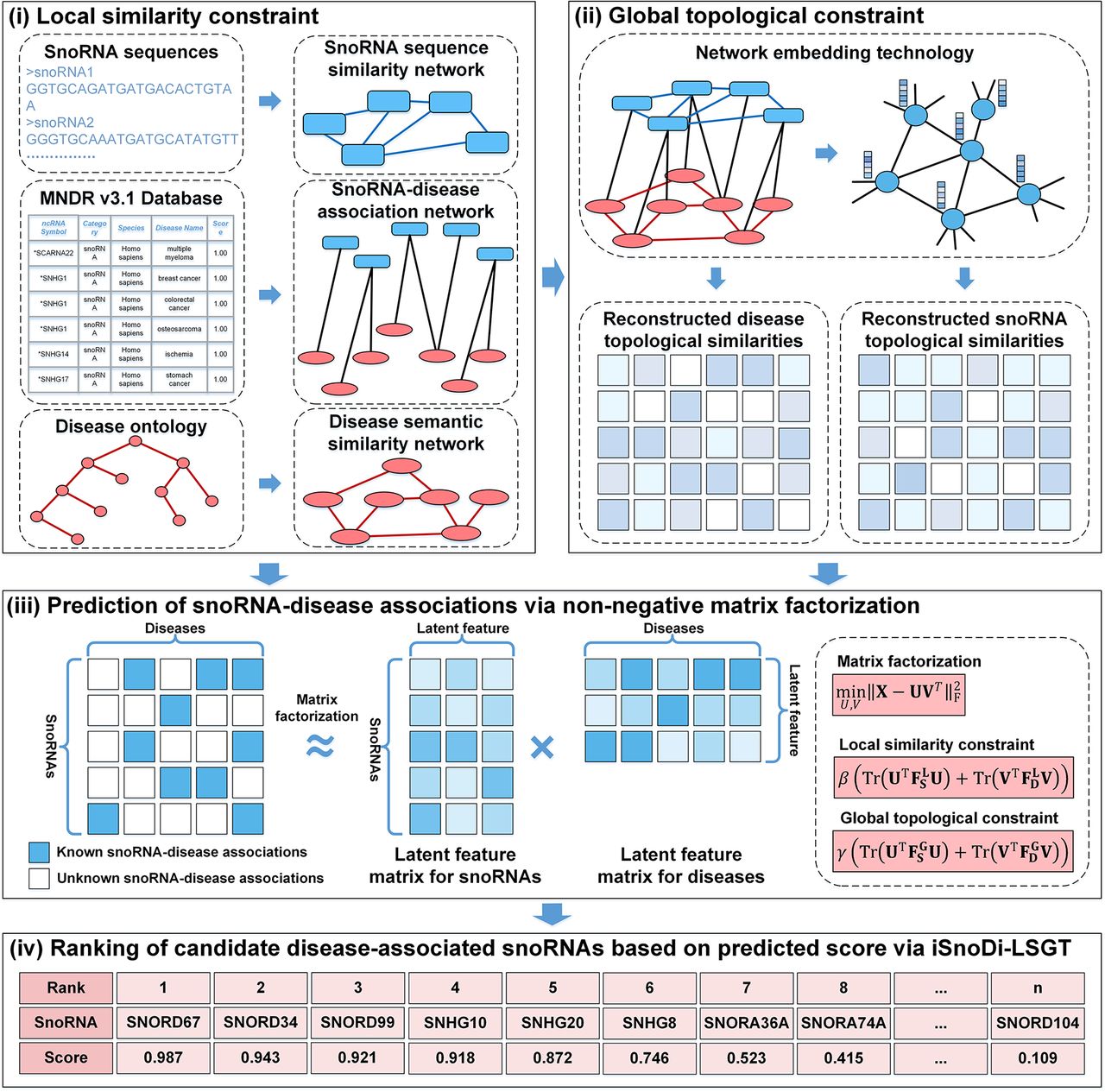
The framework of iSnoDi-LSGT predictor. The four main steps are as follows: (i) Local similarity constraint. The snoRNA sequence similarity network, snoRNA-disease association network and disease semantic similarity network are constructed, in which snoRNA sequence similarity network and disease semantic similarity network are used as local similarity constraint. (ii) Global topological constraint. Disease topological similarity and snoRNA topological similarity are calculated as global topological constraint based on network embedding technology and heterogeneous network constructed by snoRNAs, diseases and their associations. (iii) Nonnegative matrix factorization. Nonnegative matrix factorization with local similarity constraint and global topological constraint is employed to identify potential snoRNA-disease associations. (iv) Candidate disease-associated snoRNA ranking. The candidate disease-associated snoRNAs are ranked according to the scores calculated by nonnegative matrix factorization.




