


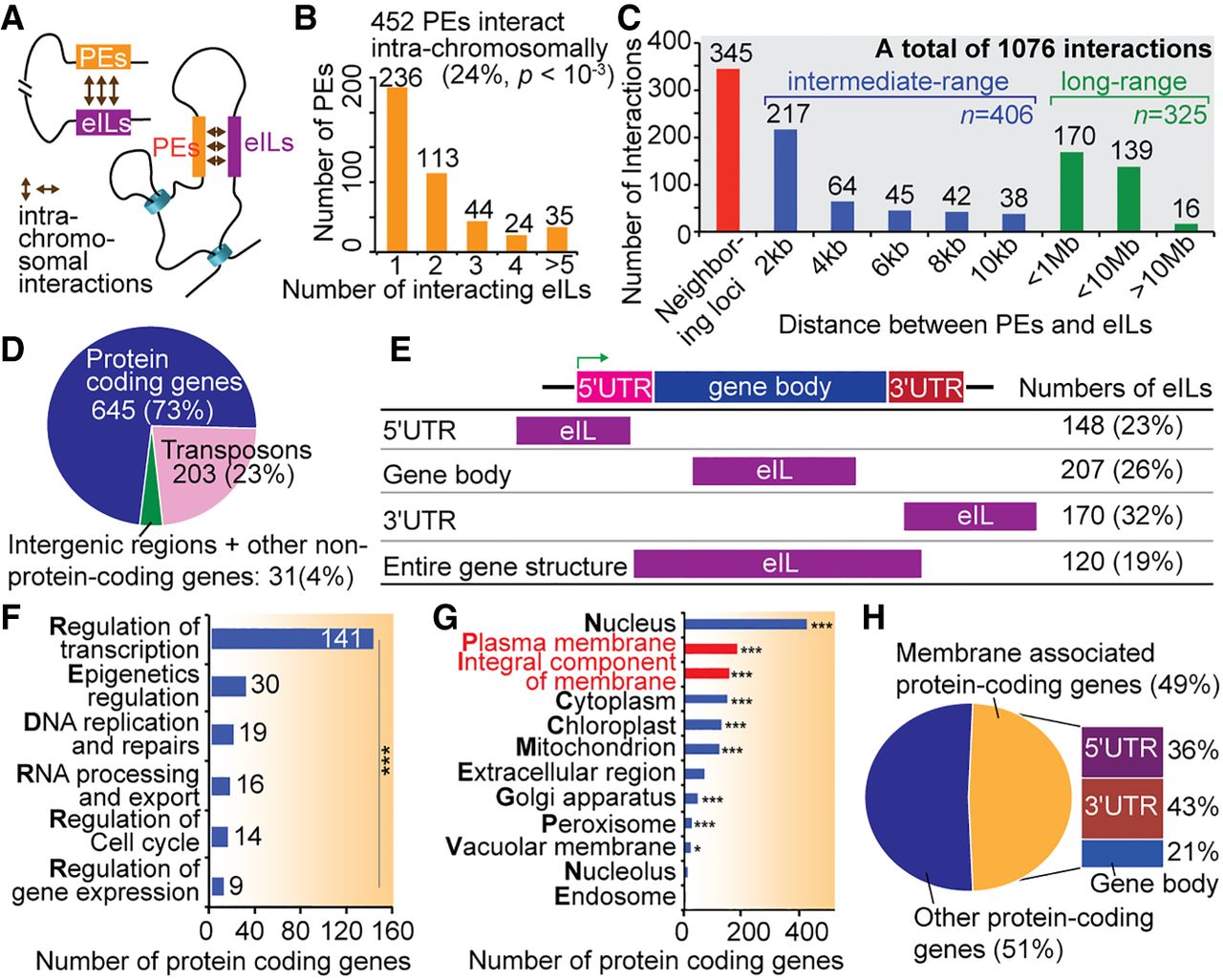
PEs can physically interact with other protein-coding genes intrachromosomally. (A) Illustration of the chromatin looping between PEs and eILs. (B) 24% (P = 1.7 × 10⁻¹⁴) of all PEs can form chromatin loops with other loci (eILs); these interactive PEs can be grouped based on the number of eILs they interact with (shown as bars). (C) The identified 1076 PE–eIL interactions fall into three groups: neighboring loci (red bars), intermediate-range interactions (2–10 kb, blue bars), and long-range interactions (>10 kb, green bars). (D) Most eILs occur in protein-coding gene regions (73%; P < 0.0001). eILs also occur in other genomic features, including TEs, intergenic regions, and other non-protein-coding genes. (E) Over 50% of eILs are mapped to 5′ UTRs and 3′ UTRs of protein-coding genes; and the rest are mapped to gene body or entire gene regions (from 5′ to 3′ UTRs of genes with length <2-kb). (F,G) GO analysis of protein-coding genes that interact with PEs (Fisher's exact test [*] P < 0.05, [***] P < 0.0001; Supplemental Dataset S13). (F) Regulation of transcription is the most frequent GO term in the molecular function category. (G) GO terms for subcellular localization show that many of the genes encode for membrane-associated functions. (H) 79% (P < 0.0001, χ2 test) of genes encoding for membrane-associated functions interact with PEs via their 5′ or 3′ UTRs.




