


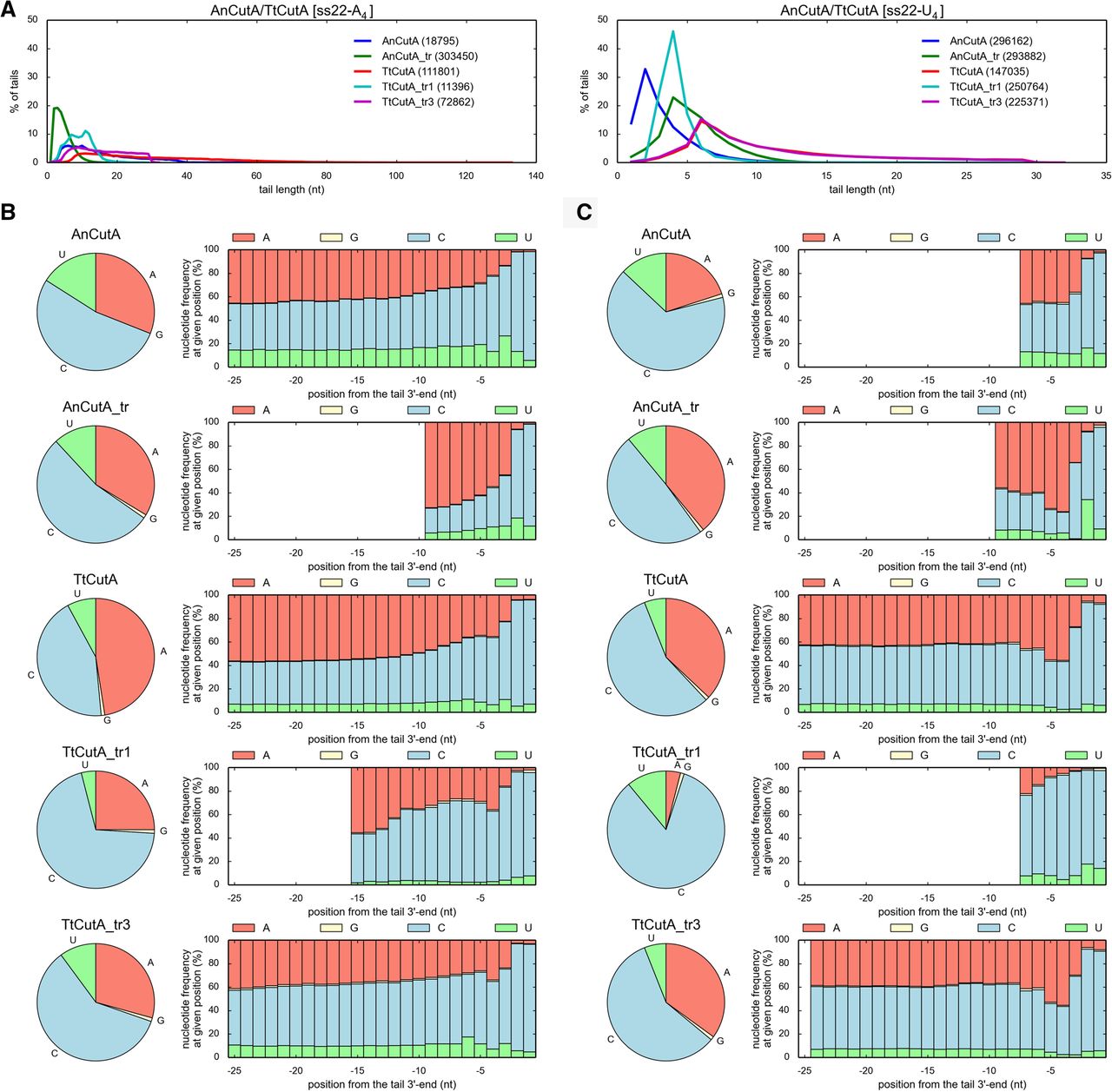
Full-length and truncated recombinant AnCutA and TtCutA proteins synthesize 3′-terminal tails rich in cytidines, most frequently ending with two C residues. (A) Length distribution for tails added by different AnCutA/TtCutA variants to ss22-A4 (left) and ss22-U4 (right) oligoribonucleotide substrates. Numbers of analyzed sequences, obtained after 3′-RACE-seq high-throughput analysis for each protein variant, are indicated in parentheses. (B,C) Analysis of nucleotide composition for tails added by different AnCutA/TtCutA variants to ss22-A4 (panel B) and ss22-U4 (panel C) RNA substrates. Pie charts demonstrate an overall frequency of incorporation of individual nucleotides into the 3′-terminal extensions. Histograms show the percentage of nucleotide types incorporated at the given position of the tail (the ultimate, 3′-terminal position is on the right). Only those positions, which were covered by at least 5% of the 3′-RACE-seq reads, are presented in the histograms. Furthermore, a limit of 25 nucleotides (nt) from the 3′-end of the tail was arbitrarily set for simplicity.




