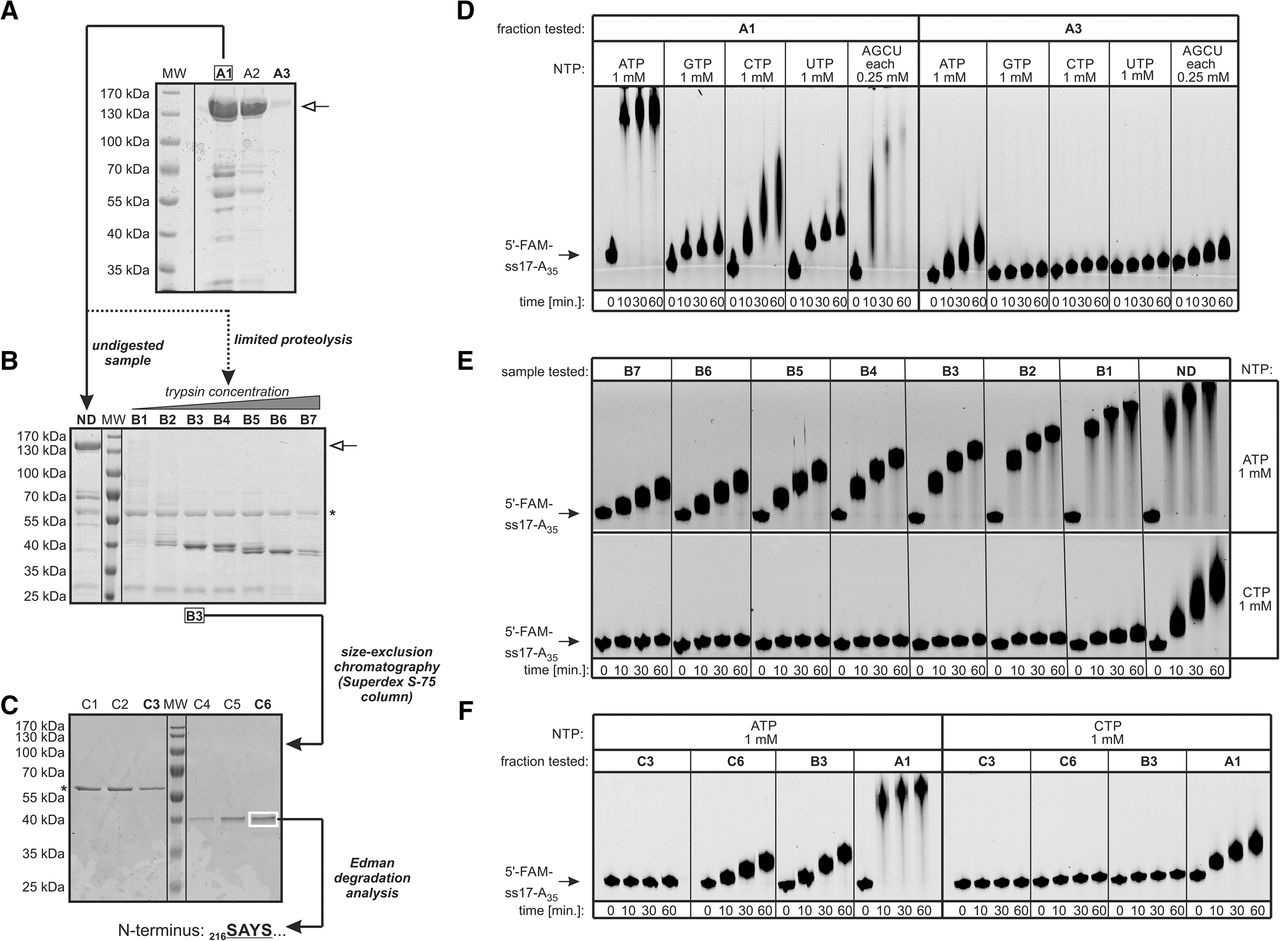
Identification of the N terminus of enzymatically active TtCutA proteolytic degradation fragment. (A) SDS-PAGE analysis of protein fractions obtained after purification of the full-length TtCutA by affinity chromatography on the nickel resin. Fraction A1 was subjected to limited proteolysis with trypsin. (B) SDS-PAGE analysis of TtCutA sample, which was not treated with trypsin (lane ND) and samples subjected to proteolytic digestion with different concentrations of trypsin (increasing from lane B1 to lane B7, as indicated above the lanes). Fraction B3 was further purified by gel filtration. (C) SDS-PAGE analysis of protein fractions obtained after separation of the TtCutA limited proteolysis products by gel filtration. Band marked with a white rectangle in lane C6 was subjected to Edman degradation analysis, which demonstrated that the N terminus of the proteolysis-derived fragment begins with S at position 216 of TtCutA, as indicated below the gel. Protein fractions were loaded on SDS-PAGE gels shown in A–C together with PageRuler Prestained Protein Ladder (Thermo Fisher Scientific) as a molecular weight marker (lanes MW). Masses of individual bands are indicated on the left. Positions of bands corresponding to the full-length protein are marked with an open arrow in A and B. Fractions highlighted in bold were tested for nucleotidyltransferase activity in the corresponding assays presented in panels D–F. (D–F) Nucleotidyltransferase activity assays were performed for protein fractions highlighted in bold in panels A–C, using 5′-FAM-ss17-A35 RNA oligonucleotide as a substrate (position indicated with an arrow). Reactions were programmed with individual NTPs or a mixture and terminated after the time points indicated below the lanes.