Table of Contents

April 2014; 20 (4)

REPORTS

  • Drosophila oskar mRNA localization in embryos has been extensively studied. Nevertheless, it has not been determined what cis-acting element(s) are responsible for dynein-dependent transport of the mRNA from nurse cells into the oocyte. This study shows that a 67-nt stem–loop in the oskar 3′ UTR is necessary and sufficient for this process.

  • This study provides new insight into how the immunoglobulin splicing inhibitor sequence blocks splicing. Evidence indicates the polypyrimidine tract binding protein bound to the splicing inhibitor element prevents U2 snRNA from base-pairing to the branch point.

ARTICLES

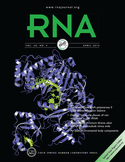
  • Our understanding of the interactions leading to high affinity binding between RNA aptamers and their target protein lag significantly behind advancements in aptamer-based diagnostics and therapeutics. This study investigates the function and 2.0-Å cocrystal structure of a methodically minimized RNA aptamer that targets hen egg white lysozyme with nanomolar affinity. The analyses reveal a novel minimalist protein–nucleic acid interface featuring a single Na+ ion stabilizing the protein-binding platform, an unusually small electrostatic component to the total free binding energy, and a surprising mode of inhibition by an RNA aptamer.

  • This paper presents detailed kinetic assays for three activities, cyclic phosphodiesterase, polynucleotide kinase, and ligase, of the trifunctional plant tRNA ligase AtRNL. Comparison with a fungal tRNA ligase, KlaTrl1, shows important functional distinctions.

  • This paper describes the effects of modulating kinase activity on alternative splicing of Rac1 in tumor cells. Specifically, knockdown of SRPK1, a kinase that phosphorylates SR proteins, reduced translocation of SRSF1 into the nucleus and thereby reduced the ability of this factor to promote inclusion of a tumor-specific exon in the Rac1 pre-mRNA.

  • Haploid male germ cells contain a unique, unusually large cytoplasmic RNP granule, the chromatoid body (CB), which emerges during the switch between the meiotic and post-meiotic phases of spermatogenesis. This paper reveals the RNA and protein composition of CBs isolated from mouse testes, and therefore provides an important basis for the functional characterization of RNP granules. The results of this study suggest a central role for the CB in the control of the highly complex transcriptome of round spermatids.

  • Ribosome ambiguity (ram) mutants cause miscoding during translation. This study analyzes two types of ram mutants, those that increase miscoding in a general way and those that alter the A site and increase miscoding in a codon-anticodon-dependent manner.

  • There has been increasing evidence implicating RNA-binding proteins (RNA-BPs) and alternative splicing in the development of cancer. In this article, the authors investigate the involvement of two hnRNP proteins, hnRNP A1/A1b and hnRNP A2/B1, in hepatocellular carcinoma. These hnRNP proteins are up-regulated in HCC tumors derived from an inflammation-induced liver cancer mouse model. They show that the levels of hnRNP A2 (but not of its splicing isoform hnRNP B1) and hnRNP A1 are critical for tumor formation. This requires the activation of the Ras-MAPK-ERK signaling pathway, which depends on the ability of hnRNP A2 to modulate splicing of A-Raf, reducing the expression of a short dominant-negative isoform.

  • It is well known that metal ions play essential roles in RNA folding and catalysis. This study examines in detail metal ions bound to specific regions of a catalytic group II intron. These analyses based on crystallographic data provide new insight into how metal ions are localized in complex folded RNA structures.

  • In recent years, there has been increasing evidence of extensive post-transcriptional regulation of miRNA biogenesis. This is sometimes accomplished by binding of RNA-binding proteins to the terminal loop of precursor miRNAs and affects Drosha and/or Dicer processing. In this study, the authors synthesized a small library of peptoids and analyzed their binding to an RNA model structure related to the stem and apical loop region of pri-miR-21. They identified a peptoid ligand that suppresses processing of a miR-21 primary transcript by association with its apical loop structure. This represents the first example of a small molecule that inhibits microprocessor-mediated processing by binding to the terminal loop of a pri-miRNA.

  • OPEN ACCESS ARTICLE

    Maturation of rRNA precursors requires an ordered series of endonucleolytic cleavages. One such cleavage site, designated A′, upstream of mature 18S rRNA has been observed in metazoa. The studies in this paper show that cleavage at A′ is not a prerequisite for downstream processing events but may be a quality control step for pre-rRNA transcripts.

  • The S. cerevisiae 5′-3′ exonuclease Rat1p is supposed to partake in transcription termination via decay of downstream RNA after 3′-end cleavage. This study reveals that rat1-1 mutant displays increased phosphorylation of RNA polymerase II C-terminal domain and transcription elongation rates and that rat1-1 phenotypes can be suppressed by overexpression of the phosphatase Fcp1p. Thus, Rat1p plays complex roles in controlling transcription that have to be considered when analyzing rat1-1 mutant phenotypes.

  • This study examines translational regulation of the GCN4 mRNA in Candida albicans. Surprisingly, unlike the homologous gene in budding yeast, a single upstream open reading frame is sufficient to regulate GCN4 translation in C. albicans. Under nonstress conditions, this microORF (uORF) represses translation. The effect of the uORF is eliminated upon stress.

  • The endoribonuclease RNase E in a range of bacteria has a conserved N-terminal catalytic domain and a less well-conserved C-terminal tail. While the role of the C-terminal tail in the formation of the degradosome, including the interaction with the polynucleotide phosphorylase PNPase, has been studied extensively in Escherichia coli, less is known about RNase E in other bacteria. In this study, Zhang and colleagues characterize RNase E in Anabaena and Synechocystis and find that, despite having C-termini that are very different from E. coli and contain an unusual RRRRRRSSA motif, the cyanobacterial enzymes also bind PNPase.

METHOD

  • In this paper, the authors present a nonradioactive Northern blotting method for the detection of miRNAs. This protocol, which takes advantage of the previously developed splinted ligation approach for detecting small RNAs, also includes cross-linking with EDC, which improves capture of small RNAs and the use of a DIG-labeled probe to eliminate the need for radioactivity.