


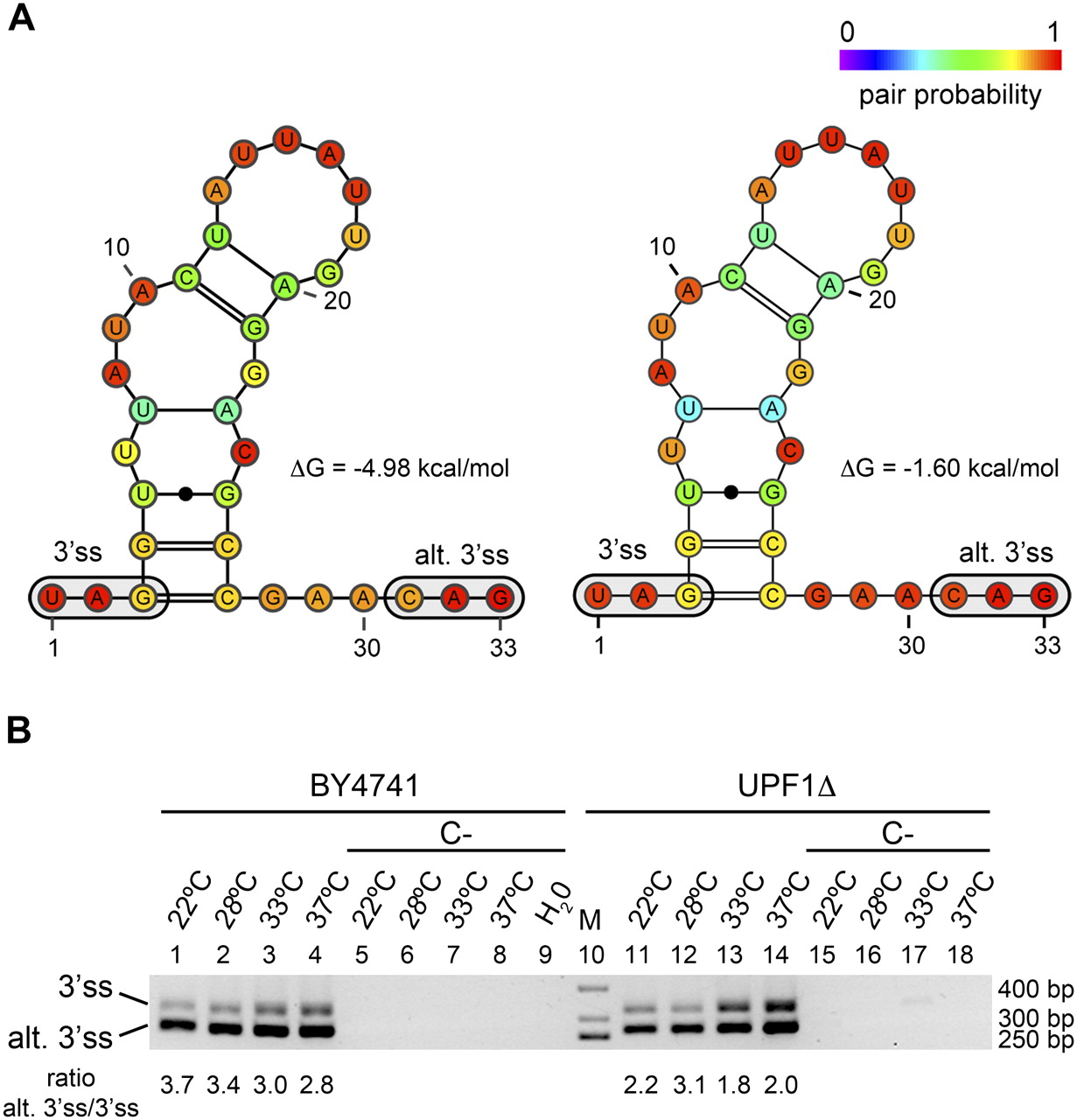
Experimental validation of an alternative 3′ss modulated by temperature in YLR211C. (A) Predicted optimal secondary structure between the BS and the alternative 3′ss predicted at 22°C (left) and at 37°C (right) for the YLR211C gene, discarding the first 7 nt after the BS A. The 3′ss and the alternative 3′ss tested (alt 3′ss) are boxed in the picture. The color of the nucleotides represents the pair probability of the bases in the secondary structure. For nucleotides outside the secondary structure, the color represents the accessibility of the nucleotide (one-pair probability) in the same scale. Even though the optimal secondary structure does not change, the stability of the optimal secondary structure decreases with temperature (ΔG 22°C = −4.98 kcal/mol; ΔG 37°C = −1.60 kcal/mol). Furthermore, a difference in the accessibility of the nucleotides from the alternative 3′ss can be observed, as calculated in Materials and Methods (see text) or as calculated from the optimal structure (average accessibility at 22°C, 0.948; accessibility at 37°C, 0.973). (B) RT-PCR validation of the splicing pattern in the YLR211C gene in two different yeast strains and at different temperature conditions. Cells were grown at the specified temperature for at least three duplications. The picture shows the RT-PCR analyses of YLR211C using RNA from strains BY4741 (lanes 1–9) and UPF1Δ (lanes 11–18). Lanes labeled with C− correspond to the negative controls with no AMV reverse transcriptase. Lane 10 contains the markers, with the corresponding lengths indicated on the right. Below, we include the rate per lane of the proportions of mRNA for the predicted alternative 3′ss over the annotated 3′ss.




