


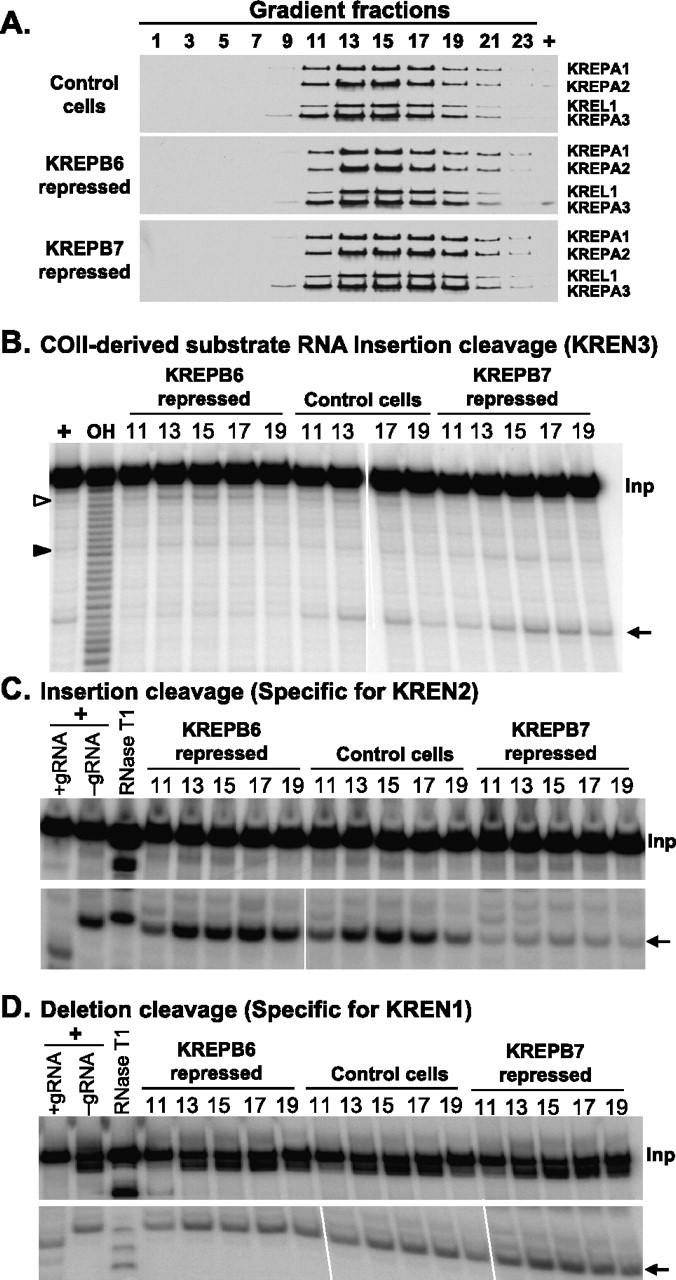
Effects of KREPB6 or KREPB7 repression on editosome sedimentation and in vitro endoribonucleolytic cleavage activity. (A) Western analysis of glycerol gradient fractions from crude mitochondrial lysates comparing KREPB6 RNAi or KREPB7 RNAi cells repressed for 6 d with nonrepressed KREPB7 RNAi cells as the control. A mixture of MAbs against the editosome components was used as indicated on the right. In vitro endoribonucleolytic cleavage activities in fractions 11–19 that are specific for sites cleaved by KREN3 (B), KREN2 (C), or KREN1 (D) endoribonucleases. Note the loss of cleavage characteristic of KREN3 upon KREPB6 knockdown, of cleavage characteristic of KREN2 upon KREPB7 knockdown, but no effect on cleavage characteristic of KREN1 by the knockdown of either KREPB6 or KREPB7 as indicated by arrows. Open and closed triangles indicate KREN2 and KREN1 cleavage sites, respectively, in COII-derived substrate in (B). Input substrate RNA (Inp) digested with RNase T1 (T1) or alkaline hydrolysis (OH) was used for size markers, pooled ∼20S editosomes from wild-type cells were used for positive reaction controls (+) and with gRNA omitted (−gRNA) as a negative control. See Materials and Methods for details.




