


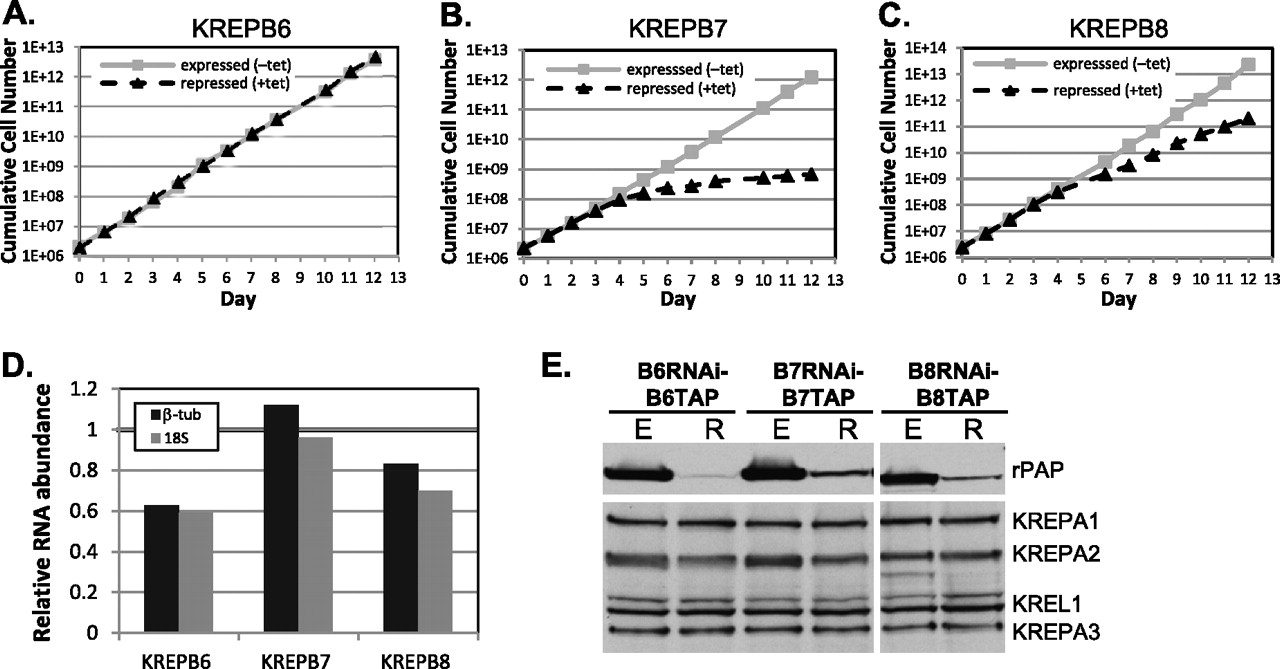
RNAi repression of KREPB6, KREPB7, or KREPB8 in procyclic form T. brucei. Growth of transgenic cells in the absence of tet (squares) and following tet induction of RNAi (triangles), which resulted in KREPB6 (A), KREPB7 (B), and KREPB8 (C) knockdown. (D) Real-time analysis of the relative abundance of KREPB6, KREPB7, or KREPB8 mRNA after 6 d with or without tet-induced RNAi. β-Tubulin (black bars) or 18S rRNA (gray bars) was used as an internal control. The thick black line at 1 indicates no relative change in mRNA level. (E) Western analyses of cell lysates following 6 d of RNAi knockdown of TAP-tagged KREPB6, KREPB7, or KREPB8. The tagged proteins were detected using the rPAP reagent, which is specific to the Protein A–tagged component of the tag, while the KREPA1, KREPA2, KREL1, and KREPA3 proteins were detected using a mixture of MAbs as indicated. E indicates expressed, and R indicates repressed by RNAi.




