


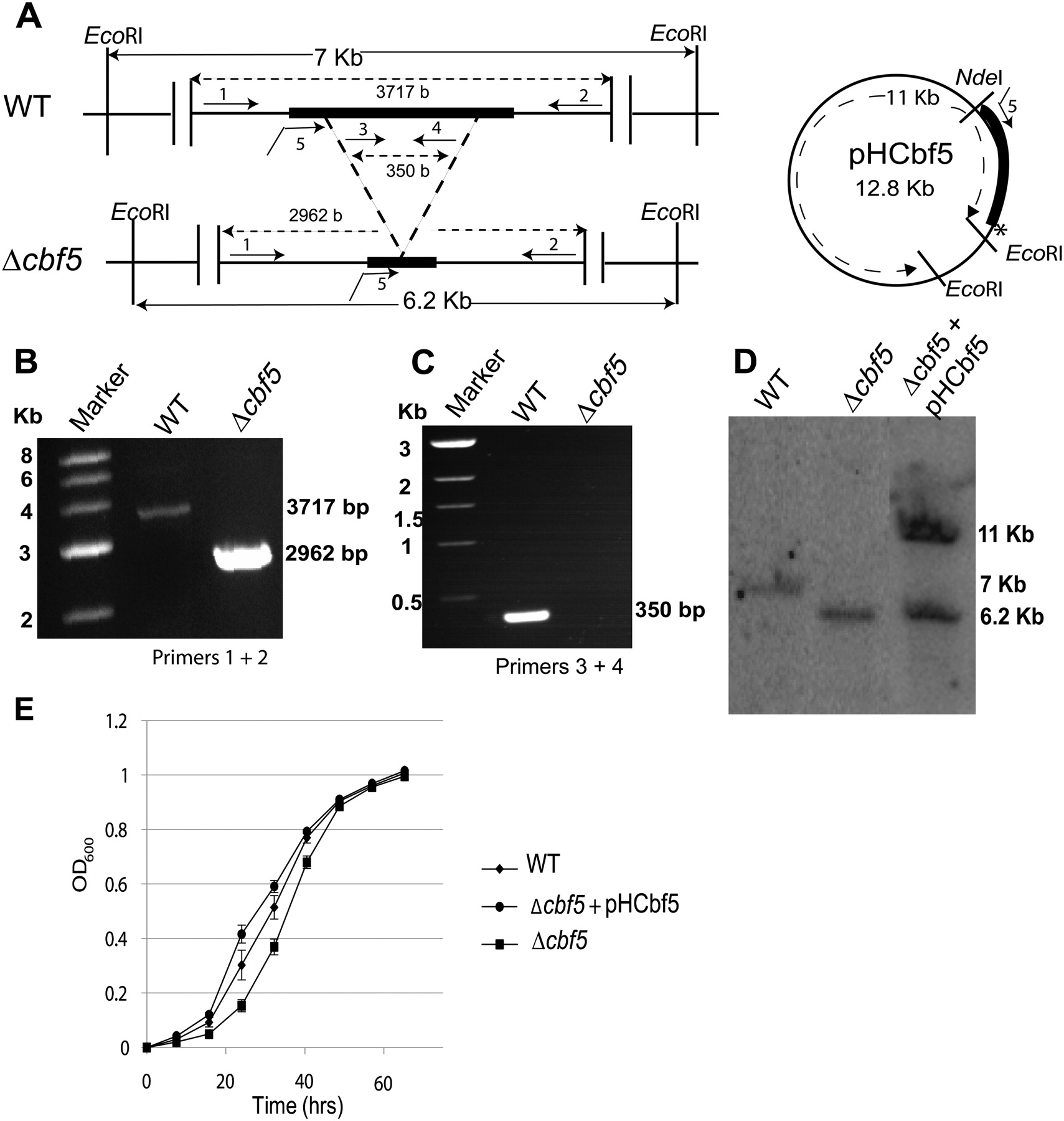
cbf5-deleted strain of H. volcanii is viable. Deletion of the cbf5 gene was confirmed by three independent methods. (A) Schematics to show HVO_2493 (thick lines) in the genomes of wild-type (WT) and cbf5-deleted (Δcbf5) strains and on plasmid pHCbf5. EcoRI and NdeI (in plasmid) sites are marked. Positions of primers 1–5 (Cbf5_Ext_Fwd, Cbf5_Ext_Rev, Cbf5_Int_Fwd, Cbf5_Int_Rew, and HVCBF5-F, respectively) are shown by arrows. The arrow direction indicates 5′ to 3′ direction of the primers. Segment between broken lines is deleted in the Δcbf5 strain. The His-tag at the C terminus of the Cbf5 protein is indicated by an asterisk. Approximate lengths of the segments are indicated but are not drawn to a scale. (B) PCR products using primers designed to anneal outside the gene (primers 1 and 2 in A) confirm a genomic rearrangement of correctly predicted sizes in WT and mutant strains. (C) PCR products using primers designed to anneal within the target gene (primers 3 and 4 in A) show the absence of the HVO_2493 segment in the mutant and its presence in the WT strain. (D) Southern hybridization is consistent with loss of the gene in mutant strain. Blots of EcoRI-digested DNAs of WT and Δcbf5 strains, and Δcbf5 strain transformed with pHCbf5 were probed with [5′-32P]-labeled HVCBF5-F primer. The predicted sizes of the hybridized fragments are indicated beside the panel. (E) Growth curves of WT, Δcbf5, and Δcbf5+pHCbf5 strains of H. volcanii are shown. OD600 was measured using a Bioscreen C apparatus. Each point is the mean of three independent cultures; error bars represent standard error. H26 and VDC2364 were used as WT and Δcbf5 strains.




