


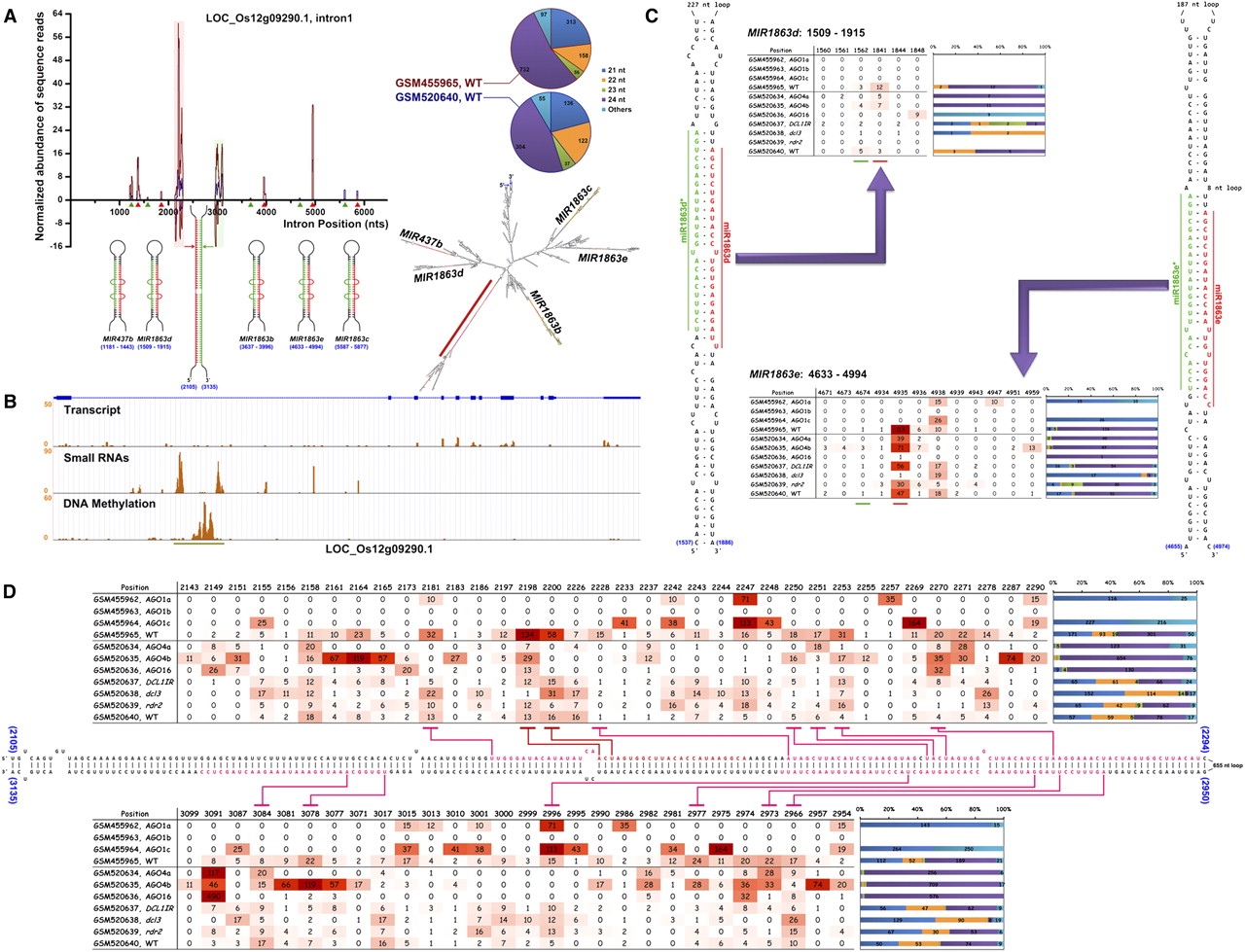
The rice introns encoding both microRNAs (miRNAs) and short interfering RNAs (siRNAs). An example of such dual-coding introns, the first intron of LOC_Os12g09290.1, is shown here. (A) Normalized abundances of the sRNAs within the intron (top left), the size distribution of sRNAs from the intron (top right), schematic presentation of the five tandem intronic miRNA precursors and a long hairpin structure (bottom left), and the predicted secondary structure of the whole intron (bottom right). The miRNAs and the miRNA*s are indicated by red and green, respectively. The complementary region of the long hairpin is highlighted in light background. The first nucleotide of the intron is set as position 1. The data are plotted at 1-base resolution. The sRNAs derived from this intron are in red on the secondary structure of the intron. The names of the miRNA genes were marked at the corresponding positions on the secondary structure of the intron with the long paired region generating siRNAs labeled with a red bar. (B) Gene and sRNA expression, and DNA methylation patterns of LOC_Os12g09290.1. The corresponding data were visualized by the UCSC Genome Browser. (C) Characterization of two newly identified MIR genes in this intron. Secondary structures of the precursor miRNAs (pre-miRNAs) (left, MIR1863d; right, MIR1863e) were predicted by RNAfold (Hofacker 2003). Configuration tables with bar charts (colored as in A) show the number and the percentage of sRNAs in each high-through sequencing library derived from these two MIR gene loci. Positions generating mature miRNAs and miRNA*s are denoted by red and green bars, respectively. (D) Number and percentage of siRNAs derived from the long hairpin, colored as in C. Only positions with more than 10 siRNA reads in at least one library are shown. For both C and D, numbers in parentheses indicate the sequence positions within the intron. (WT) Wild type.




