


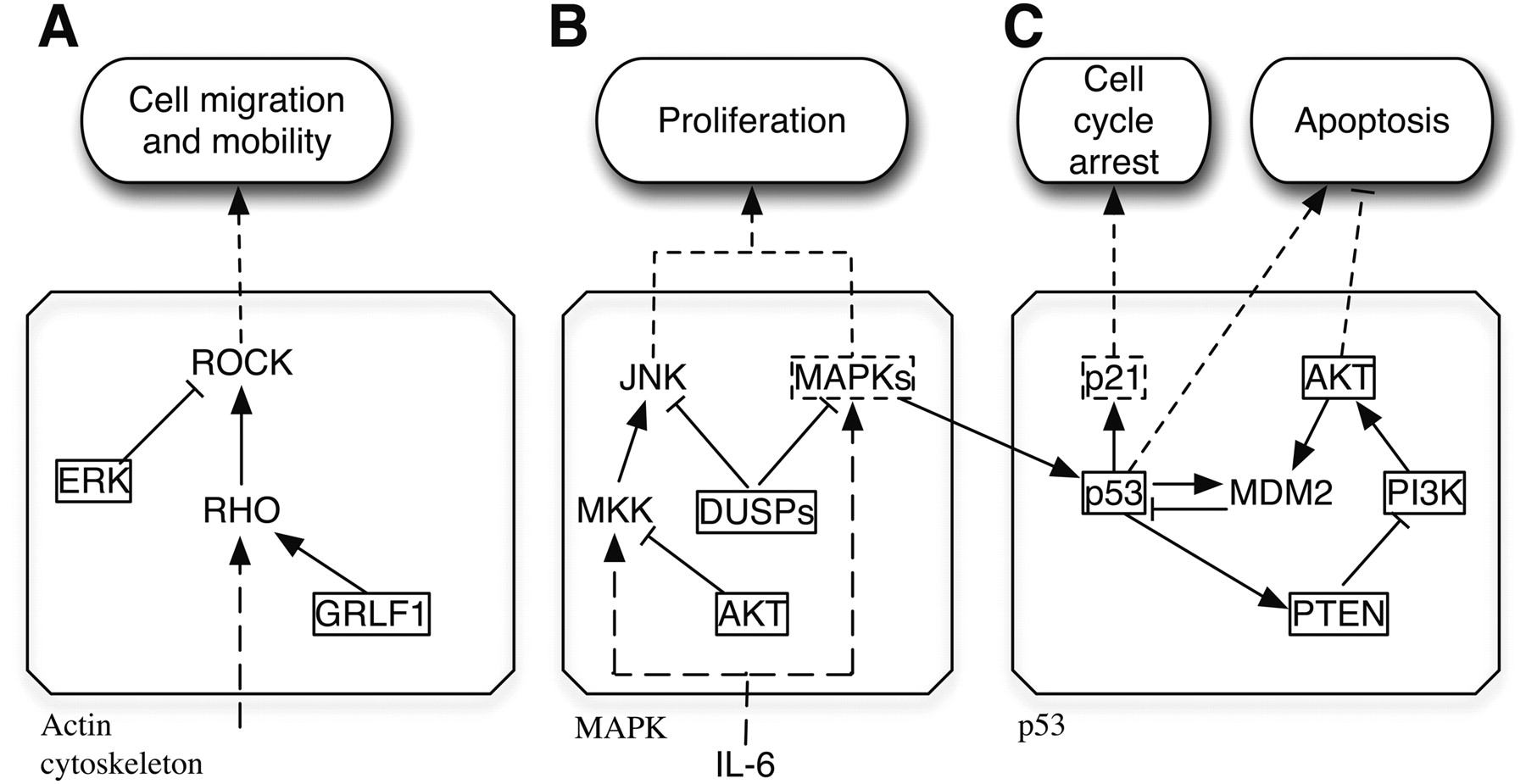
Model for central prostate cancer-related processes and their miRNA-mediated regulation. Solid-framed transcripts are predicted targets by miR-106b-25 cluster and/or miR-22. Dashed-framed transcripts are validated miRNA target genes. Arrows indicate activation, dashed lines inducement, and blunted arrows inhibition. (A) RHO/ROCK (RHO kinase) signaling regulates actin cytoskeletal dynamics in several metastatic tumors (Malliri and Collard 2003). ERK/MAPK regulates the actin cytoskeleton and contraction required to drive cell motility, whereas a down-regulation of ERK leads to cell migration (Zohrabian et al. 2009). We found ERK and GRLF1 targeted by miR-106b-25. (B) IL-6 mediated cell proliferation via activation of the MAPK pathway. Down-regulation of AKT and DUSP lead to an activation of MKK/JNK (Farooq and Zhou 2004), which is required for the growth of prostate carcinoma (Shimada et al. 2007). We found inhibitors such as AKT and DUSP targeted by miR-106b-25 and miR-22 indicating the oncomir character of the queried miRNAs. (C) Activation of the p53 pathway is induced by MAPK. The p53 pathway is actively involved in cell-cycle arrests and p53-dependent apoptosis (Scott et al. 2003; Cano et al. 2009). We found central players of cell-cycle arrest targeted by miR-106b-25 and miR-22. Ivanovska et al. (2008) showed that p21 is a direct target of miR-106b and that its silencing plays a key role in cell-cycle progression by modulating check point functions.




