


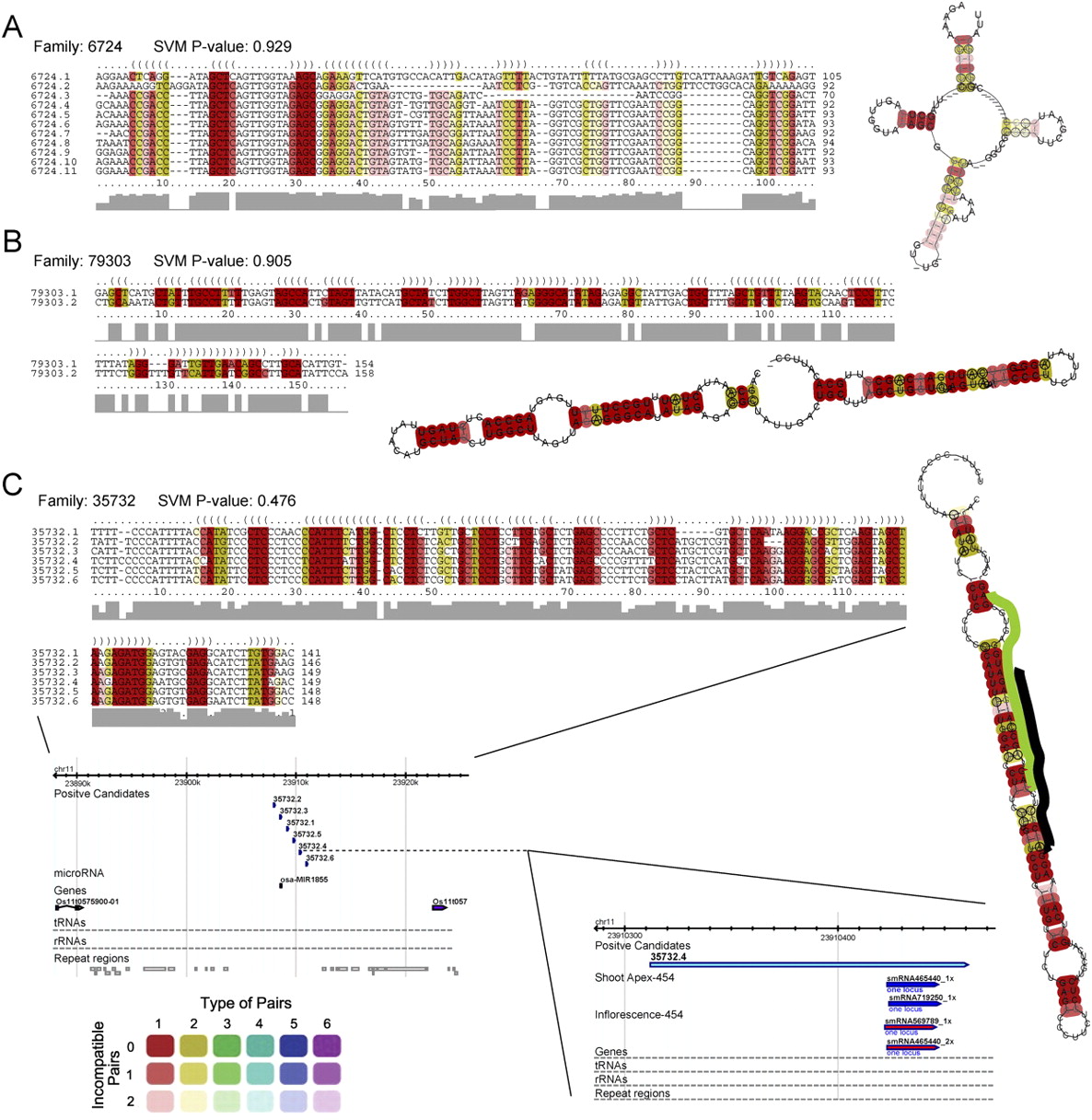
Selected candidate ncRNA families. SVM P-values and consensus structures are shown for each family. (A) A novel tRNA family including tRNATyr, tRNAPhe, and tRNA pseudogenes, with an intron inserted in the anticodon loop. (B) Novel box H/ACA snoRNAs. Element 79303.1 was experimentally confirmed in this study. (C) Novel isoforms of MIR1855. Element 35732.4 is predicted as a novel microRNA supported by 454 sequencing reads mapping on the mature region. (Black line along the hairpin structure) The mature MIR1855; (green line) the mature microRNA region of the 35732.4 element predicted in this study. Base pairs are colored by the RNAalifold program (Bernhart et al. 2008), using the following rules: Background colors indicate the number of different types of base pairs that support the structure from 1 (red) to 6 (purple). Pale backgrounds indicate that a base pair cannot be formed in some sequences of the alignment. Pairs in which one pairing partner is encircled exhibit consistent mutations, whereas pairs supported by compensatory mutations have both bases marked. Pairs that cannot be formed by some of the sequences are gray instead of black.




