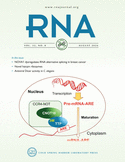
A-MYB/TCFL5 regulatory architecture ensures the production of pachytene piRNAs in placental mammals
- Tianxiong Yu1,
- Adriano Biasini1,
- Katharine Cecchini1,
- Martin Saflund2,
- Haiwei Mou3,
- Amena Arif1,
- Atiyeh Eghbali2,
- Dirk de Rooij4,
- Zhiping Weng1,
- Phillip D. Zamore1 and
- Deniz M. Ozata2,5
- 1 University of Massachusetts Medical School;
- 2 Stockholm University;
- 3 Cold Spring Harbor Laboratory;
- 4 Utrecht University
- ↵* Corresponding author; email: deniz.ozata{at}su.se
Abstract
In male mice, the transcription factor A MYB initiates the transcription of pachytene piRNA genes during meiosis. Here, we report that A MYB activates the transcription factor Tcfl5 produced in pachytene spermatocytes. Subsequently, A MYB and TCFL5 reciprocally reinforce their own transcription to establish a positive feedback circuit that triggers pachytene piRNA production. TCFL5 regulates the expression of genes required for piRNA maturation and promotes transcription of evolutionarily young pachytene piRNA genes, whereas A-MYB activates the transcription of older pachytene piRNA genes. Intriguingly, pachytene piRNAs from TCFL5-dependent young loci initiates the production of piRNAs from A-MYB-dependent older loci ensuring the self-propagation of pachytene piRNAs. A MYB and TCFL5 act via a set of incoherent feedforward loops that drive regulation of gene expression by pachytene piRNAs during spermatogenesis. This regulatory architecture is conserved in rhesus macaque, suggesting that it was present in the last common ancestor of placental mammals.
Keywords
- Received October 6, 2022.
- Accepted October 7, 2022.
- Published by Cold Spring Harbor Laboratory Press for the RNA Society
This article, published in RNA, is available under a Creative Commons License (Attribution 4.0 International), as described at http://creativecommons.org/licenses/by/4.0/.