The stem cell-specific protein TRIM71 inhibits maturation and activity of the pro-differentiation miRNA let-7 via two independent molecular mechanisms
- Lucia A Torres Fernández1,5,
- Sibylle Mitschka1,
- Thomas Ulas2,
- Stefan Weise1,
- Kilian Dahm1,
- Matthias Becker3,
- Kristian Händler3,
- Marc Beyer4,
- Julia Windhausen1,
- Joachim L Schultze2 and
- Waldemar Kolanus1
- 1 Life and Medical Sciences Institute (LIMES), University of Bonn;
- 2 German Center for Neurodegenerative Diseases (DZNE) & Life and Medical Sciences Institute (LIMES), University of Bonn;
- 3 German Center for Neurodegenerative Diseases (DZNE), University of Bonn;
- 4 Life and Medical Sciences Institute (LIMES)
- ↵* Corresponding author; email: torres.fernandez.lucia{at}gmail.com
Abstract
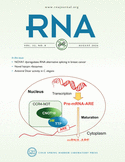
The stem cell-specific RNA-binding protein TRIM71/LIN-41 was the first identified target of the pro-differentiation and tumor suppressor miRNA let-7. TRIM71 has essential functions in embryonic development and a proposed oncogenic role in several cancer types, such as hepatocellular carcinoma. Here, we show that TRIM71 regulates let-7 expression and activity via two independent mechanisms. On the one hand, TRIM71 enhances pre-let-7 degradation through its direct interaction with LIN28 and TUT4, thereby inhibiting let-7 maturation and indirectly promoting the stabilization of let-7 targets. On the other hand, TRIM71 represses the activity of mature let-7 via its RNA-dependent interaction with the RNA-Induced Silencing Complex (RISC) effector protein AGO2. We found that TRIM71 directly binds and stabilizes let-7 targets, suggesting that let-7 activity inhibition occurs on active RISCs. MiRNA enrichment analysis of several transcriptomic datasets from mouse embryonic stem cells and human hepatocellular carcinoma cells suggests that these let-7 regulatory mechanisms shape transcriptomic changes during developmental and oncogenic processes. Altogether, our work reveals a novel role for TRIM71 as a miRNA repressor and sheds light on a dual mechanism of let-7 regulation.
Keywords
- RNA-binding protein (RBP)
- TRIM71/LIN-41
- let-7 miRNA family
- miRNA pathway
- stem cell and cancer biology
- Received January 29, 2021.
- Accepted April 29, 2021.
- Published by Cold Spring Harbor Laboratory Press for the RNA Society
This article is distributed exclusively by the RNA Society for the first 12 months after the full-issue publication date (see http://rnajournal.cshlp.org/site/misc/terms.xhtml). After 12 months, it is available under a Creative Commons License (Attribution-NonCommercial 4.0 International), as described at http://creativecommons.org/licenses/by-nc/4.0/.