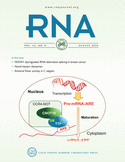
Activation of innate immunity by mitochondrial dsRNA in mouse cells lacking p53 protein.
- Dagmara M. Wiatrek1,
- Maria E. Candela1,
- Jiří Sedmík1,
- Jan Oppelt2,
- Liam P. Keegan1 and
- Mary A. O'Connell1,3
- 1 CEITEC;
- 2 CEITEC; National Centre for Biomolecular Research, Faculty of Science, Masaryk University
- ↵* Corresponding author; email: mary.oconnell{at}ceitec.muni.cz
Abstract
Viral and cellular double-stranded RNA (dsRNA) is recognized by cytosolic innate immune sensors including RIG-I-like receptors. Some cytoplasmic dsRNA is commonly present in cells, and one source is mitochondrial dsRNA, which results from bidirectional transcription of mitochondrial DNA (mtDNA). Here we demonstrate that Trp 53 mutant mouse embryo fibroblasts contain immune-stimulating endogenous dsRNA of mitochondrial origin. We show that the immune response induced by this dsRNA is mediated via RIG-I-like receptors and leads to the expression of type I interferon and proinflammatory cytokine genes. The mitochondrial dsRNA is cleaved by RNase L, which cleaves all cellular RNA including mitochondrial mRNAs, increasing activation of RIG-I-like receptors. When mitochondrial transcription is interrupted there is a subsequent decrease in this immune stimulatory dsRNA. Our results reveal that the role of p53 in innate immunity is even more versatile and complex than previously anticipated. Our study, therefore, sheds new light on the role of endogenous RNA in diseases featuring aberrant immune responses.
Keywords
- Received November 26, 2018.
- Accepted March 16, 2019.
- Published by Cold Spring Harbor Laboratory Press for the RNA Society
This article is distributed exclusively by the RNA Society for the first 12 months after the full-issue publication date (see http://rnajournal.cshlp.org/site/misc/terms.xhtml). After 12 months, it is available under a Creative Commons License (Attribution-NonCommercial 4.0 International), as described at http://creativecommons.org/licenses/by-nc/4.0/.