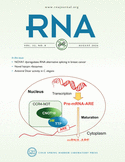
CeFra-seq reveals broad asymmetric mRNA and non-coding RNA distribution profiles in Drosophila and human cells.
- Louis Philip Benoit Bouvrette1,
- Neal A.L. Cody1,
- Julie Bergalet1,
- Fabio Alexis Lefebvre1,
- Cédric Diot1,
- Xiaofeng Wang1,
- Mathieu Blanchette2 and
- Eric Lécuyer1,3
- ↵* Corresponding author; email: eric.lecuyer{at}ircm.qc.ca
Abstract
Cells are highly asymmetrical, a feature that relies on the sorting of molecular constituents, including proteins, lipids and nucleic acids, to distinct subcellular locales. The localization of RNA molecules is an important layer of gene regulation required to modulate localized cellular activities, although its global prevalence remains unclear. We combine biochemical cell fractionation with RNA sequencing (CeFra-seq) analysis to assess the prevalence and conservation of RNA asymmetric distribution on a transcriptome-wide scale in Drosophila and human cells. This approach reveals that the majority (>80%) of cellular RNA species are asymmetrically distributed, whether considering coding and non-coding transcript populations, in patterns that are broadly conserved evolutionarily. Notably, a large number of Drosophila and human long non-coding RNAs and circular RNAs display enriched levels within specific cytoplasmic compartments, suggesting that these RNAs fulfill extra-nuclear functions. Moreover, fraction-specific mRNA populations exhibit distinctive sequence characteristics. Comparative analysis of mRNA fractionation profiles with that of their encoded proteins reveals a general lack correlation in subcellular distribution, marked by strong cases of asymmetry. However, coincident distribution profiles are observed for mRNA/protein pairs related to a variety of functional protein modules, suggesting complex regulatory inputs of RNA localization to cellular organization.
Keywords
- Cellular Organization
- Messenger RNA and Non-Coding RNA
- RNA Localization
- RNA-sequencing
- Subcellular fractionation
- Received July 27, 2017.
- Accepted October 13, 2017.
- Published by Cold Spring Harbor Laboratory Press for the RNA Society
This article is distributed exclusively by the RNA Society for the first 12 months after the full-issue publication date (see http://rnajournal.cshlp.org/site/misc/terms.xhtml). After 12 months, it is available under a Creative Commons License (Attribution-NonCommercial 4.0 International), as described at http://creativecommons.org/licenses/by-nc/4.0/.