Precursor MicroRNA-122 Inhibits Synthesis of Insig1 Isoform mRNA by Modulating Polyadenylation Site Usage
- ↵* Corresponding author; email: psarnow{at}stanford.edu
Abstract
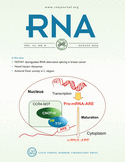
The insulin-induced gene 1 protein (Insig1) inhibits the cholesterol biosynthesis pathway by retaining transcription factor SREBP in the endoplasmic reticulum, and by causing the degradation of HMGCR, the rate-limiting enzyme in cholesterol biosynthesis. Liver-specific microRNA miR-122, on the other hand, enhances cholesterol biosynthesis by an unknown mechanism. We have found that Insig1 mRNAs are generated by alternative cleavage and polyadenylation, resulting in specific isoform mRNA species. During high cholesterol abundance, the short 1.4kb Insig1 mRNA was found to be preferentially translated to yield Insig1 protein. Precursor molecules of miR-122 downregulated the translation of the 1.4kb Insig1 isoform mRNA by interfering with the usage of the promoter proximal cleavage-polyadenylation site that gives rise to the 1.4kb Insig1 mRNA. These findings argue that precursor miR-122 molecules modulate polyadenylation site usage in Insig1 mRNAs, resulting in downregulation of Insig1 protein abundance. Thus, precursor microRNAs may have hitherto undetected novel functions in nuclear gene expression.
Keywords
- Received July 21, 2017.
- Accepted September 9, 2017.
- Published by Cold Spring Harbor Laboratory Press for the RNA Society
This article is distributed exclusively by the RNA Society for the first 12 months after the full-issue publication date (see http://rnajournal.cshlp.org/site/misc/terms.xhtml). After 12 months, it is available under a Creative Commons License (Attribution-NonCommercial 4.0 International), as described at http://creativecommons.org/licenses/by-nc/4.0/.