


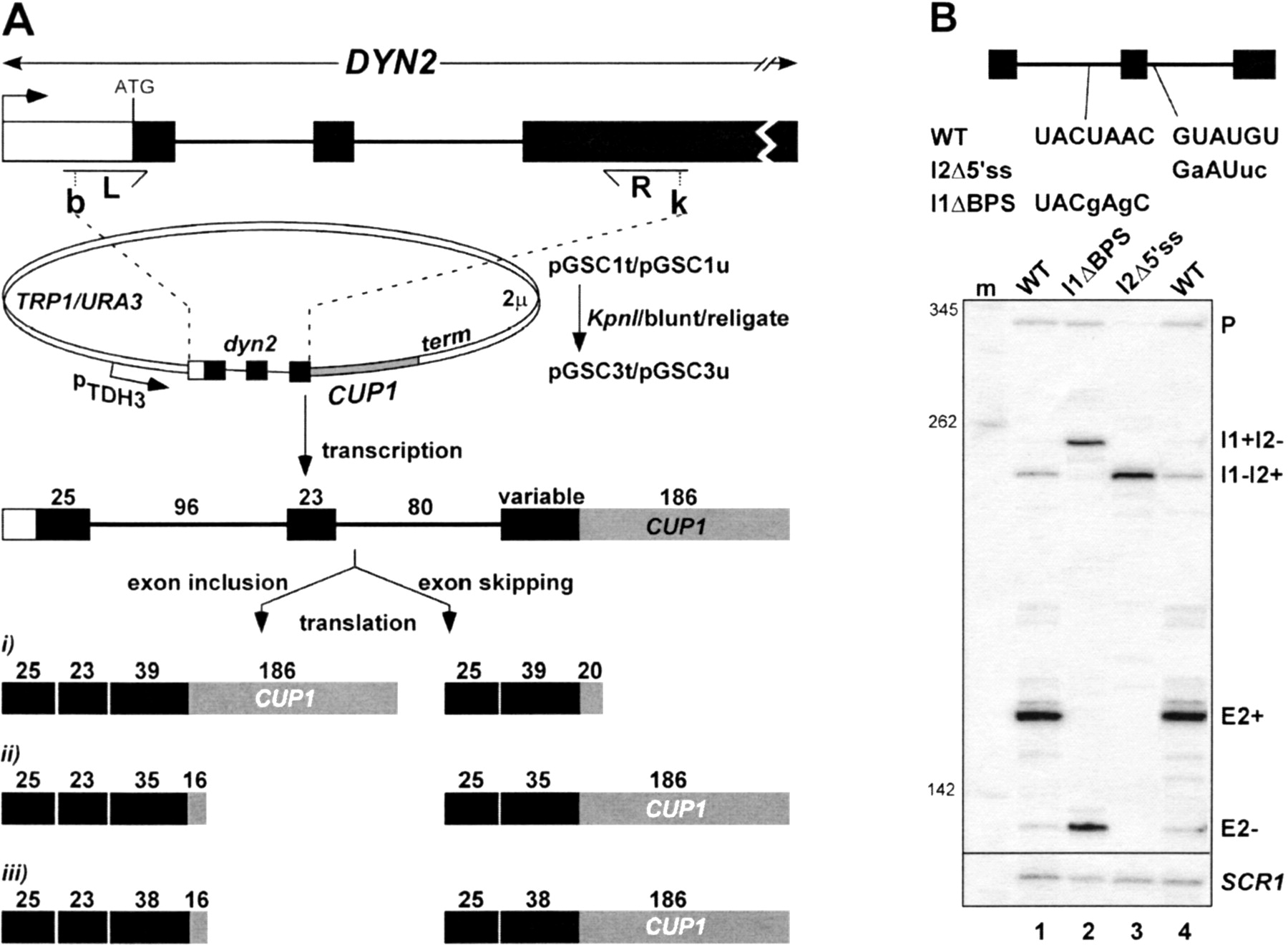
Cloning and in vivo expression of dyn2-Cup1 constructs. (A) PCR amplification and cloning of DYN2 sequences into CUP1 expression vectors. The 5′ and 3′ PCR primers (L and R, respectively) introduce BamHI (b) and KpnI (k) sites for cloning. Lengths of the exons (filled boxes represent coding regions) and introns (lines) are indicated in the “pre-mRNA”. Variability in the DYN2 third exon length (see Materials and Methods) enabled us to use different constructs as Cup1 protein expression reporters for exon inclusion and skipping splicing. In schemes i–iii, full-length or truncated proteins are predicted, depending on the number of coding bases (indicated above) in the exon-included and exon-skipped mRNAs. For example, the pGSC1 plasmids allow Cup1p expression only from the exon included mRNA (scheme i), whereas exon skipped mRNA encodes a truncated polypeptide due to translation termination early in the CUP1 coding region. In contrast, the pGSC3 plasmids (scheme ii) permits Cup1p expression only from mRNAs lacking the internal exon, whereas exon-included mRNAs encode truncated polypeptide. Scheme iii was used for constructs derived from the low/moderate stringency screen described in the text and in Figure 2. (B) RT analysis of precursor and spliced mRNAs from wild type and mutant dyn2-Cup1 expression constructs (scheme ii translational reading frame). Sequences of the mutated splice sites are indicated (changes from the genomic sequence are shown in lowercase). WT indicates wild-type sequence. Expected products are as follows: P, pre-mRNA containing both introns; I1+I2−, intron 1 retained and intron 2 removed; I1−I2+, intron 1 removed and intron 2 retained; E2+, exon 2 included; E2−, both introns removed as a single intron and exon 2 skipped; and m, pUC13 Sau3AI DNA size markers. Reactions were normalized to cDNA derived from reverse transcription of SCR1, an RNAP III transcript.




