


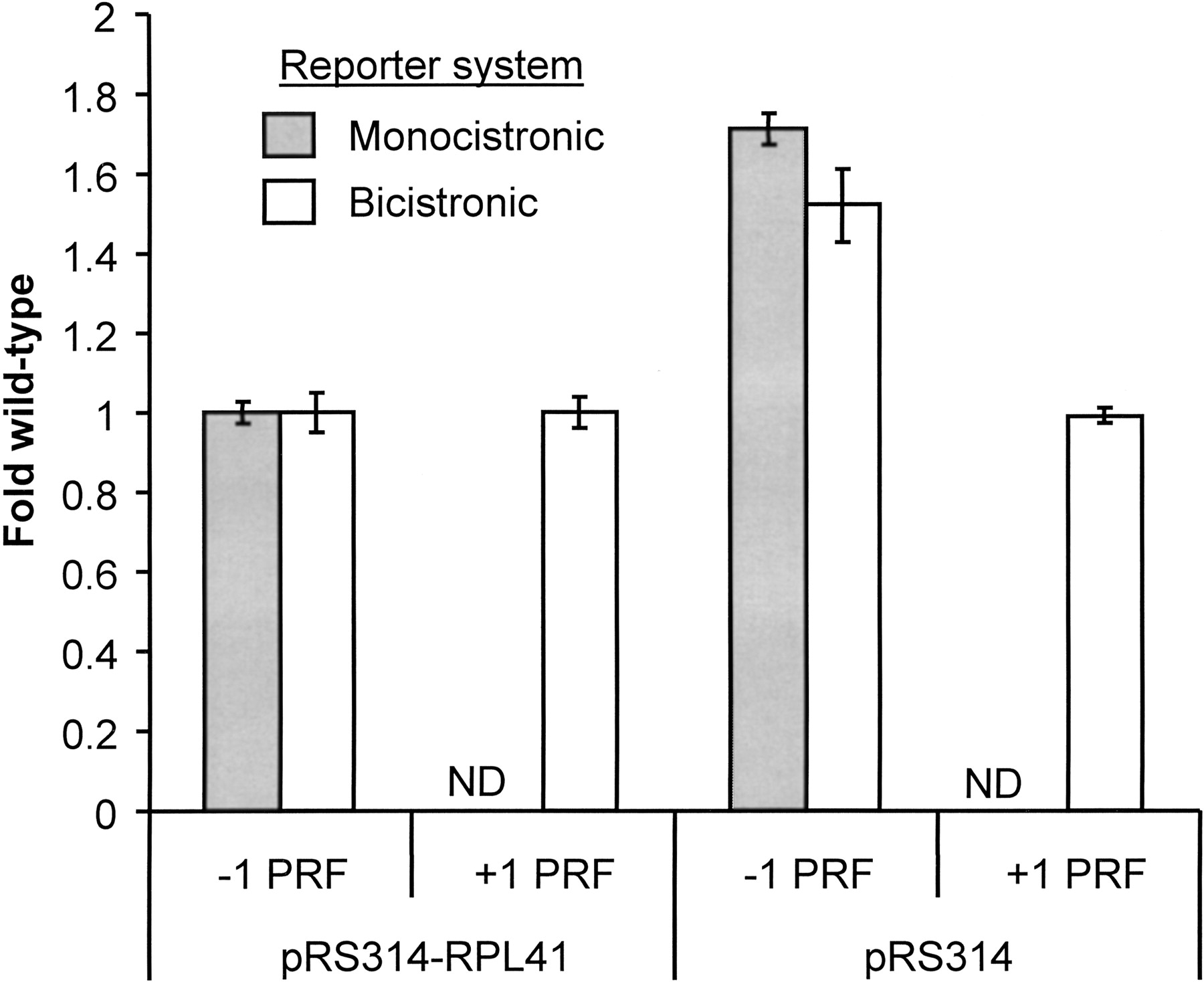
Programmed −1 ribosomal frameshifting is specifically stimulated in L41-deficient yeast cells. Isogenic XY5a strains (MATa ade2-1 trp1-1 his3-11,15 can1-100 ura3-1 leu2-3,112 rpl41a|mBHIS3 rpl41b|mBURA3) harboring pRS314–RPL41A or pRS314 were cotransformed with either monocistronic or bicistronic p0, p−1 or p+1 LEU2–CEN6-based reporter vectors. Changes in frameshift efficiencies are depicted in terms of fold wild-type (see Table 1). Programmed ribosomal frameshifting efficiencies using the monocistronic reporters were determined as described (Dinman et al. 1991; Peltz et al. 1999). ND: Not determined. In the assays using the bicistronic reporter system, Renilla and firefly luciferase activities of clarified cell lysates were determined using Dual-Luciferase Assay Reagents (Promega) and quantitiated using a TD20/20 lumineter (Turner designs). Frameshifting efficiencies were calculated by dividing the firefly/Renilla luminescence ratios from the −1 and +1 programmed frameshift test reporters by the 0-frame control reporter. Each dataset represents the averages of three individual experiments repeated in triplicate. Error bars denote standard deviations from the means.




