


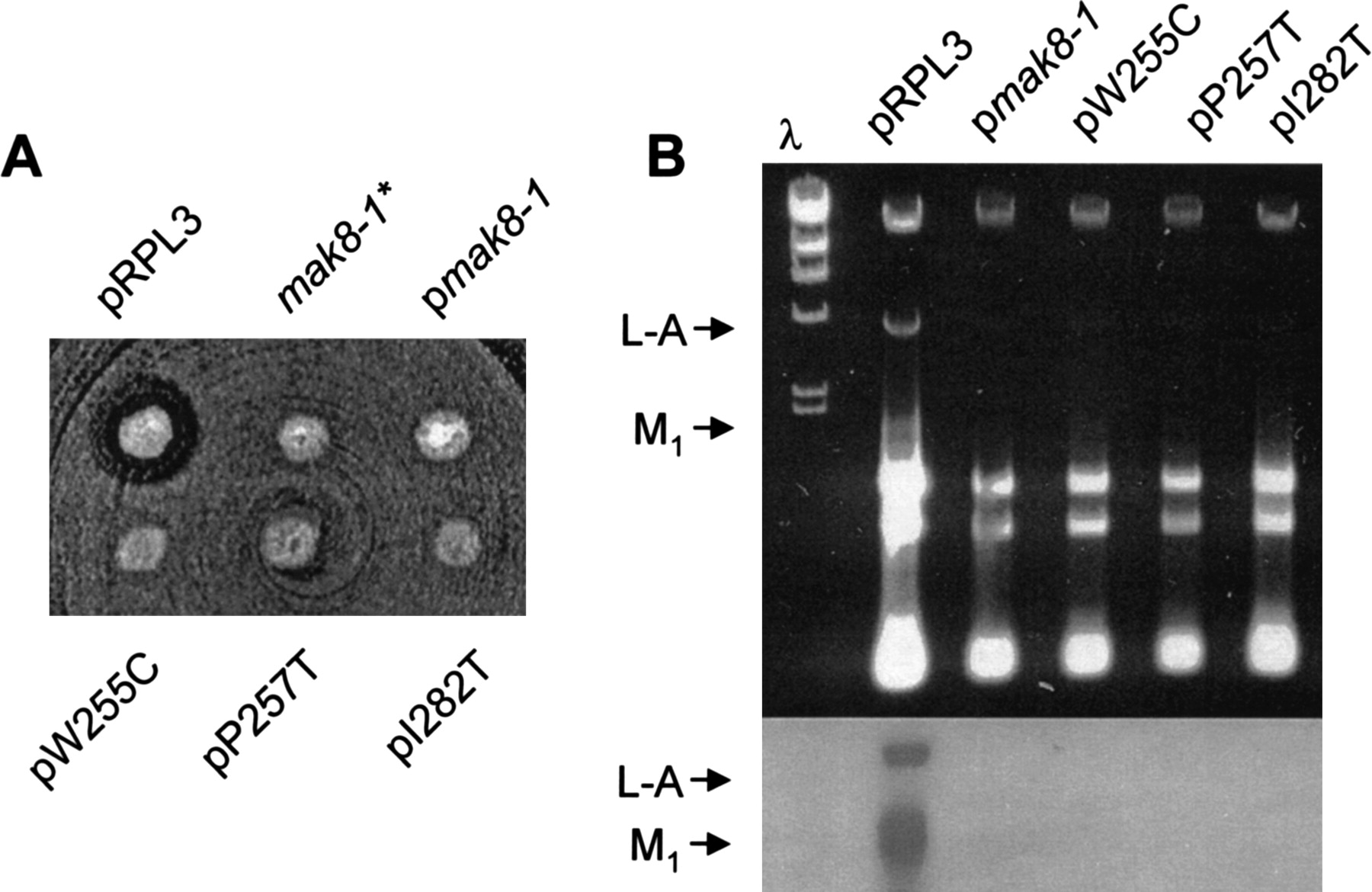
The rpl3 mutant alleles cannot propagate the yeast killer virus. (A) Killer assay of strains harboring the wild-type RPL3 gene or mutant alleles. Isogenic Killer+ strains containing the RPL3|mBHIS3 gene disruption and harboring the wild-type RPL3 gene on a URA3–CEN6 plasmid were transformed with TRP1–CEN6 plasmids containing either the wild-type gene or the indicated rpl3 alleles. After selection on medium lacking tryptophan, cells having lost the URA3–CEN6 plasmids were identified by their ability to grow on medium containing 5-FOA. Colonies were then replica plated onto a lawn of cells that are sensitive to the secreted killer toxin produced by the M1 satellite virus of L-A. Killer activity was observed as a zone of growth inhibition around the colonies. mak8-1* is not isogenic with the other strains, but is rather the original mak8-1 isolate (RW1906) used here for comparison. (B) Total RNAs isolated from the isogenic strains described in (A) were separated through a 1.5% TAE-agarose gel. L-A and M1 dsRNAs are indicated as 2.5- and 1.8-kbp bands, respectively. Top panel shows the ethidium bromide stained gel and the bottom panel is a Northern blot of the gel probed for the presence of L-A and M1 (−) strand viral RNAs were performed as previously described (Dinman and Wickner 1994).




