


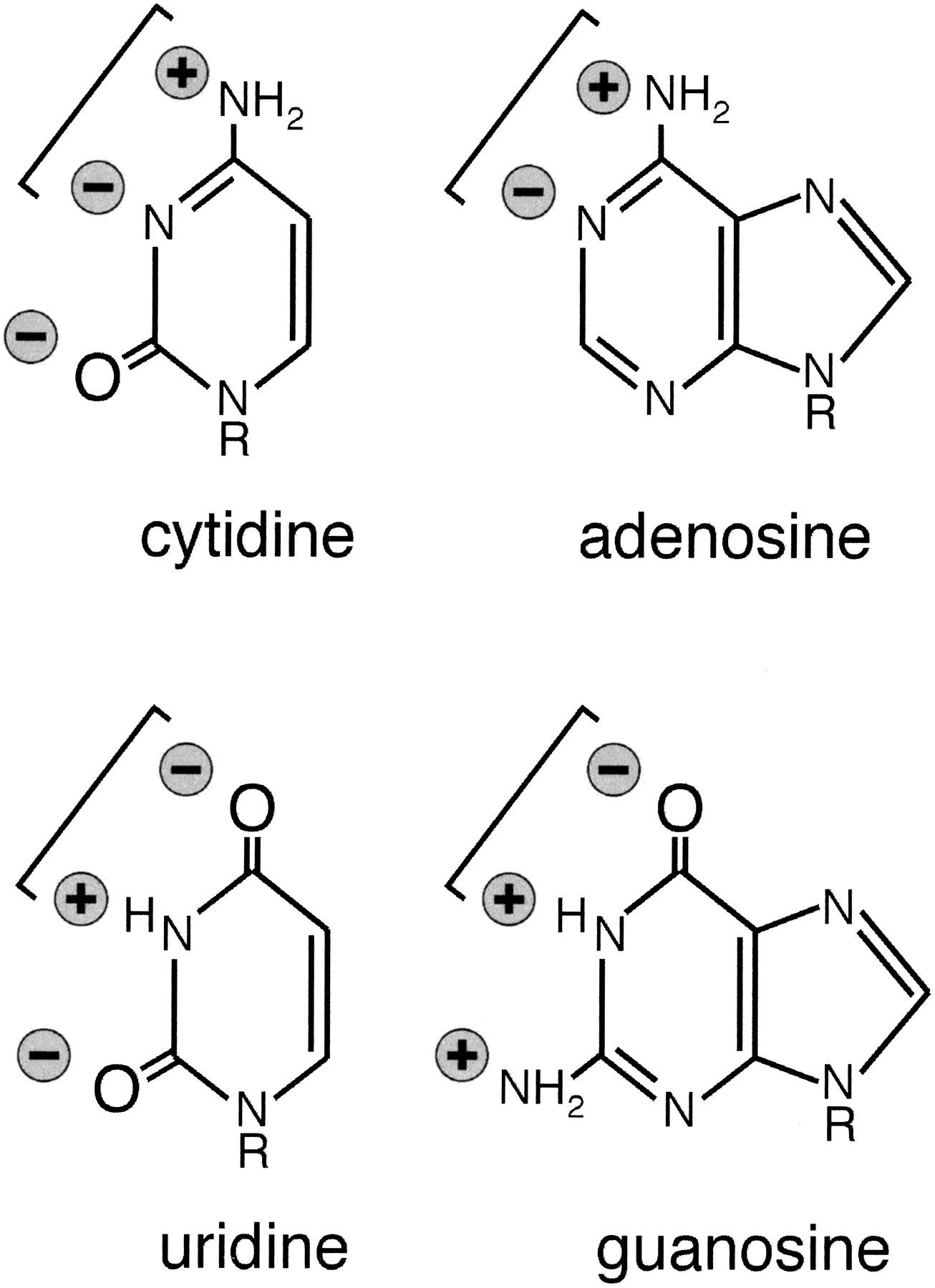
FIGURE 7.
The enzyme may recognize C and A, and discriminate against U and G, by forming hydrogen bonds (“base pairing”) with the 3 and 4 positions of pyrimidines and the equivalent 1 and 6 positions of purines (indicated by brackets, where + indicates hydrogen bond donor and − hydrogen bond acceptor). The cartoon combines functional data (this study) with structural data for the B. stearothermophilus class I CCA-adding enzyme complexed with CTP and ATP (Li et al. 2002). In the crystal structure, the nucleotide-binding site also “base pairs” with N-3 of ATP.




