


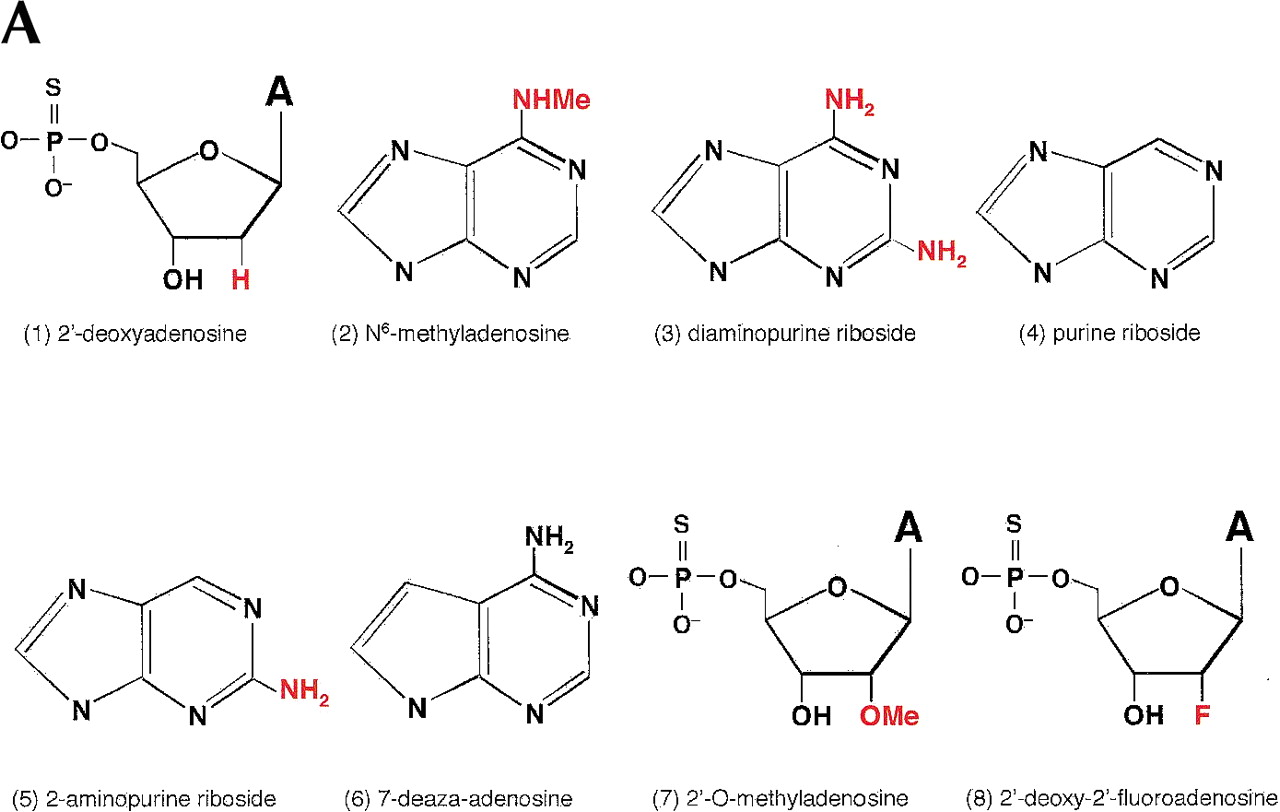
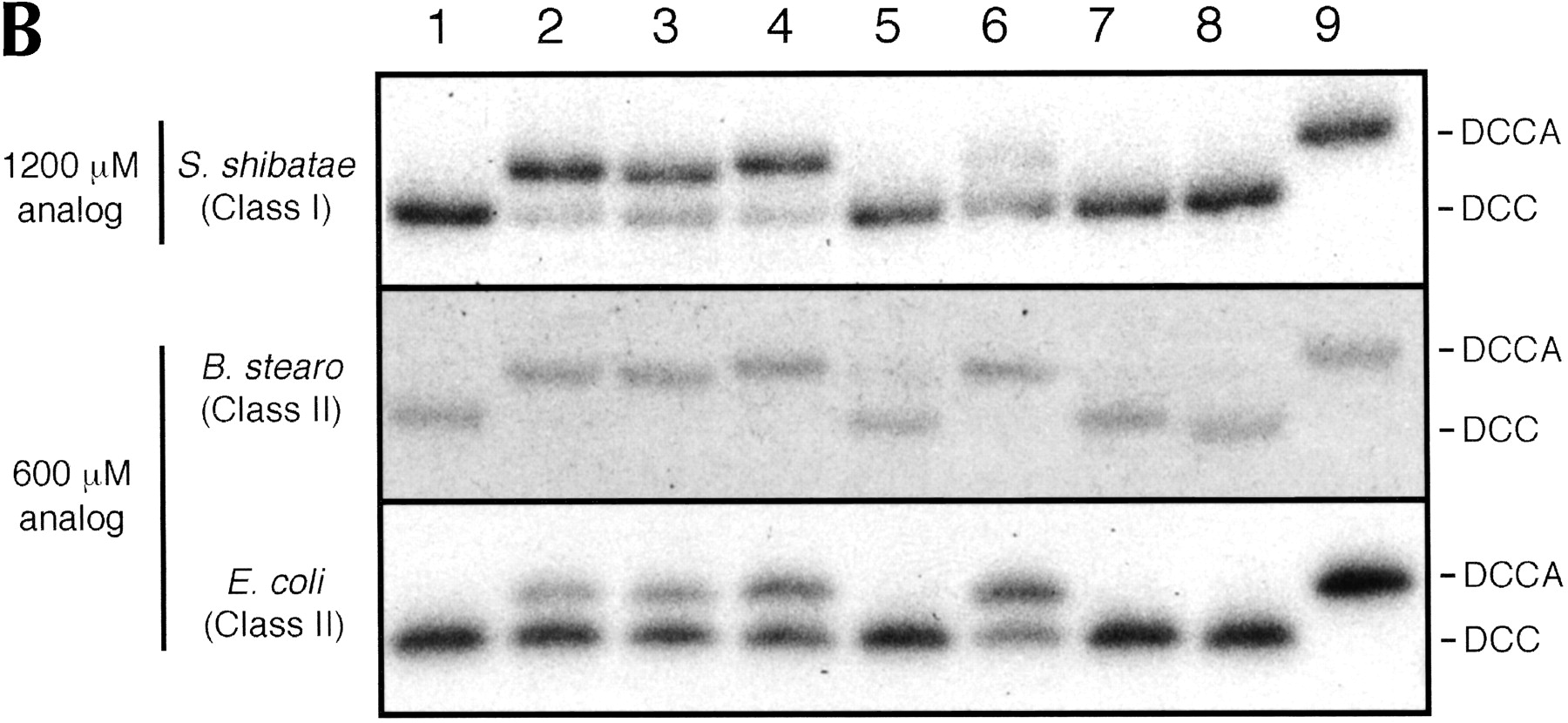
Addition of ATP analogs to tRNA-DCC. (A) ATP analogs tested, with modifications indicated in red. (B) Incorporation of ATP analogs into tRNA substrates lacking 3′-terminal A was assayed for the class I S. shibatae enzyme at high analog concentration (1200 μM) and 70°C (upper panel). The class II B. stearothermophilus and E. coli enzymes were assayed at lower analog concentration (600 μM) and 55°C or 37°C, respectively (lower panel). The analogs are 2′-deoxyadenosine (lane 1), N6-methyladenosine (lane 2), diaminopurine riboside (lane 3), purine riboside (lane 4), 2-aminopurine riboside (lane 5), 7-deaza-adenosine (lane 6), 2′-O-methyladenosine (lane 7), 2′-deoxy-2′-fluoroadenosine (lane 8). ATP (rightmost lane) was 300 μM in all assays. Under these conditions, the ATP reactions go to completion in 5 min (data not shown); these assays were carried out for 15 min to screen for analogs that are inefficiently incorporated. Assays as in Figure 2B.




