


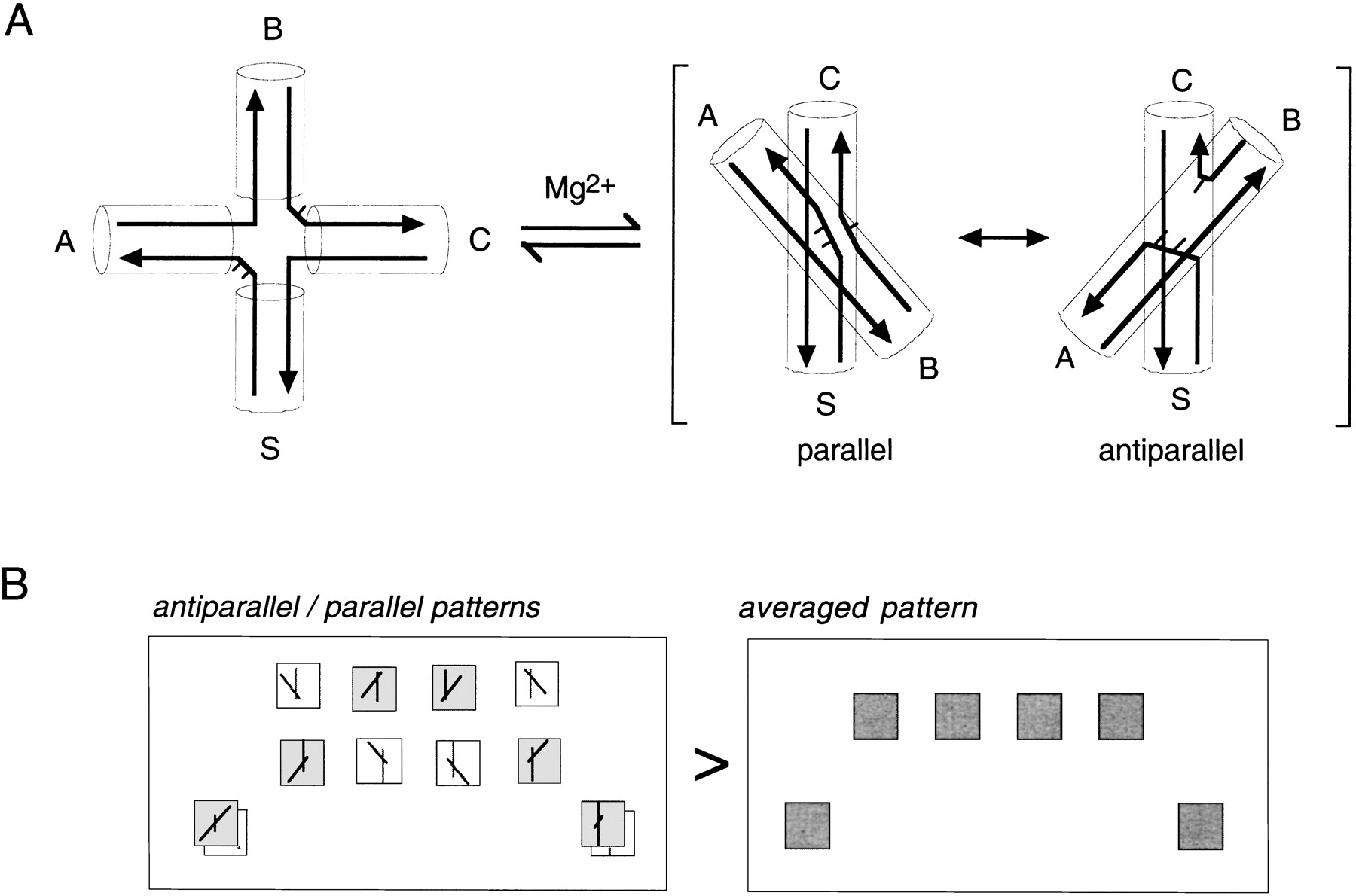
A dynamic structure for the HCV IRES IIIabc junction in solution. (A) The natural IRES junction adopts an unstacked, extended structure in the absence of divalent metal ions, in contrast to the 4H junction. On addition of magnesium ions, the structure is best described by an equilibrium mixture of antiparallel and parallel stacked forms of the junction. (B) A rapid exchange between the antiparallel and parallel forms explains the electrophoretic pattern observed in the presence of magnesium ions. The antiparallel structure gives the set of shaded species (as found in the folded 4H junction), whereas the parallel structure is predicted to give the fast-slow-intermediate-intermediate-slow-fast pattern. Rapid exchange would lead to the average pattern illustrated, which is closely similar to that predicted for a static stacked 90° form, and to that observed experimentally for the IRES junction (Fig. 2B left,). Right- and left-handed forms of each conformation are possible, and only the simplest transition is illustrated.




