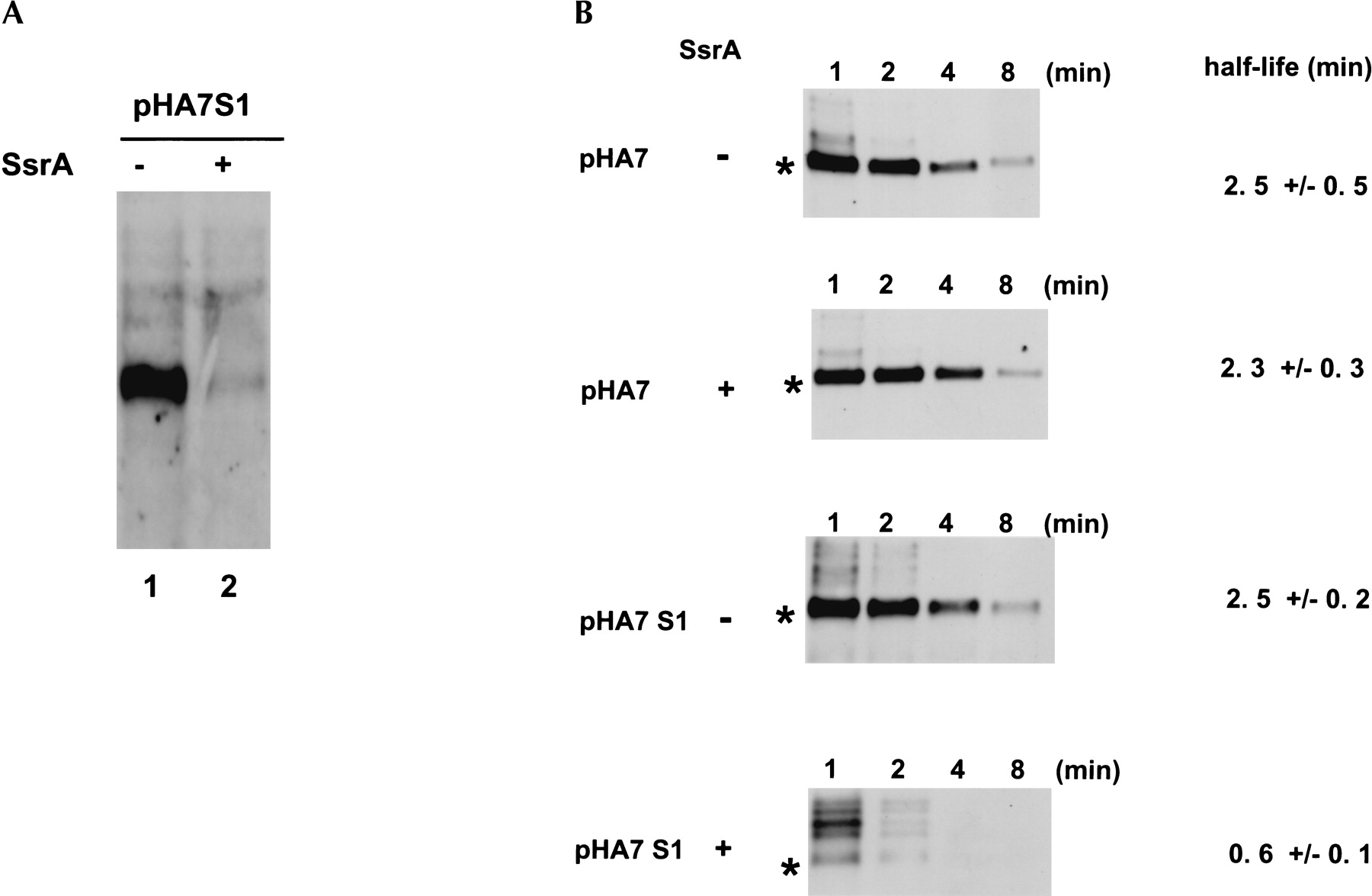
Effect of SsrA RNA on the stability of normal and nonstop crp mRNAs. (A) Northern blot analysis of crp mRNAs derived from the pHA7 and pHA7S1. The crp mRNAs were expressed in TA331 (ssrA−) and W3110 (ssrA+) harboring pHA7 or pHA7S1. Total RNAs (5 μg) were subjected to Northern blot analysis using a DIG-labeled 5′ probe A. The major crp mRNA band is shown by an asterisk. (B) Northern blot analysis of crp mRNAs prepared from rifampicin-treated cells. W3110 (ssrA+) and TA331 (ssrA−) harboring pHA7 or pHA7S1 were grown to OD600 = 0.8. Rifampicin (200 μg/mL) was added to prevent further initiation of transcription. Cellular RNAs were prepared at indicated times after the addition of rifampicin. Total RNAs (10 μg) were subjected to Northern blot analysis. The bands corresponding to the major crp mRNA indicated by asterisks were quantified using Bioimage Analyzer LAS-1000 (Fuji). Half-lives were determined by plotting the percent of mRNA remaining versus time on a semilog plot. The values are the average of three independent experiments.