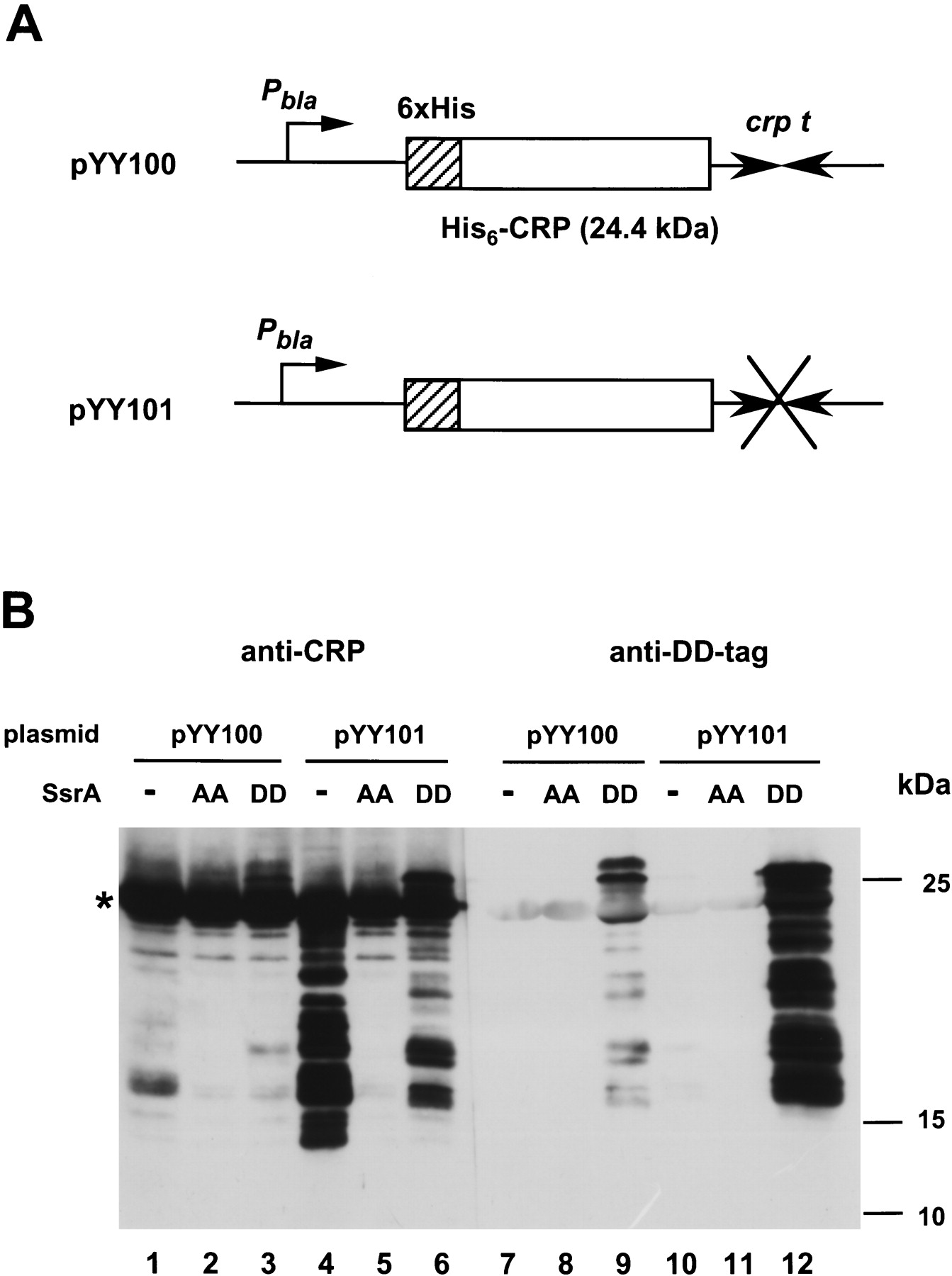
Western blot analysis of His6-CRP proteins derived from the wild-type and terminatorless crp genes. (A) Schematic drawing of the wild-type and terminatorless crp genes encoding His6-CRP in pYY100 and pYY101. The elevated arrow denotes the start and direction of transcription. The hatched and open rectangles represent the coding regions for 6 × His and CRP, respectively. The figure is not drawn to scale. The ρ-independent crp terminator is shown by horizontal arrows. (B) Western blot analysis of His6-CRP proteins. The His6-CRP proteins were expressed in three different strains, TA331 (ssrA−), W3110 (ssrA+), and TA371 (ssrADD), harboring pYY100 and pYY101. W3110 (ssrA+) and TA371 (ssrADD) express the wild-type SsrA RNA (AA) and SsrADD RNA (DD), respectively. The proteins were purified by Ni2+-NTA affinity chromatography. The purified proteins of 1 μg were subjected to Western blot analysis using anti-CRP antibodies (lanes 1–6) and anti-DD-tag antibodies (lanes 7–12). The position of the full-length His6 CRP (24.4 kD) is shown by an asterisk. Size standards are on the right.