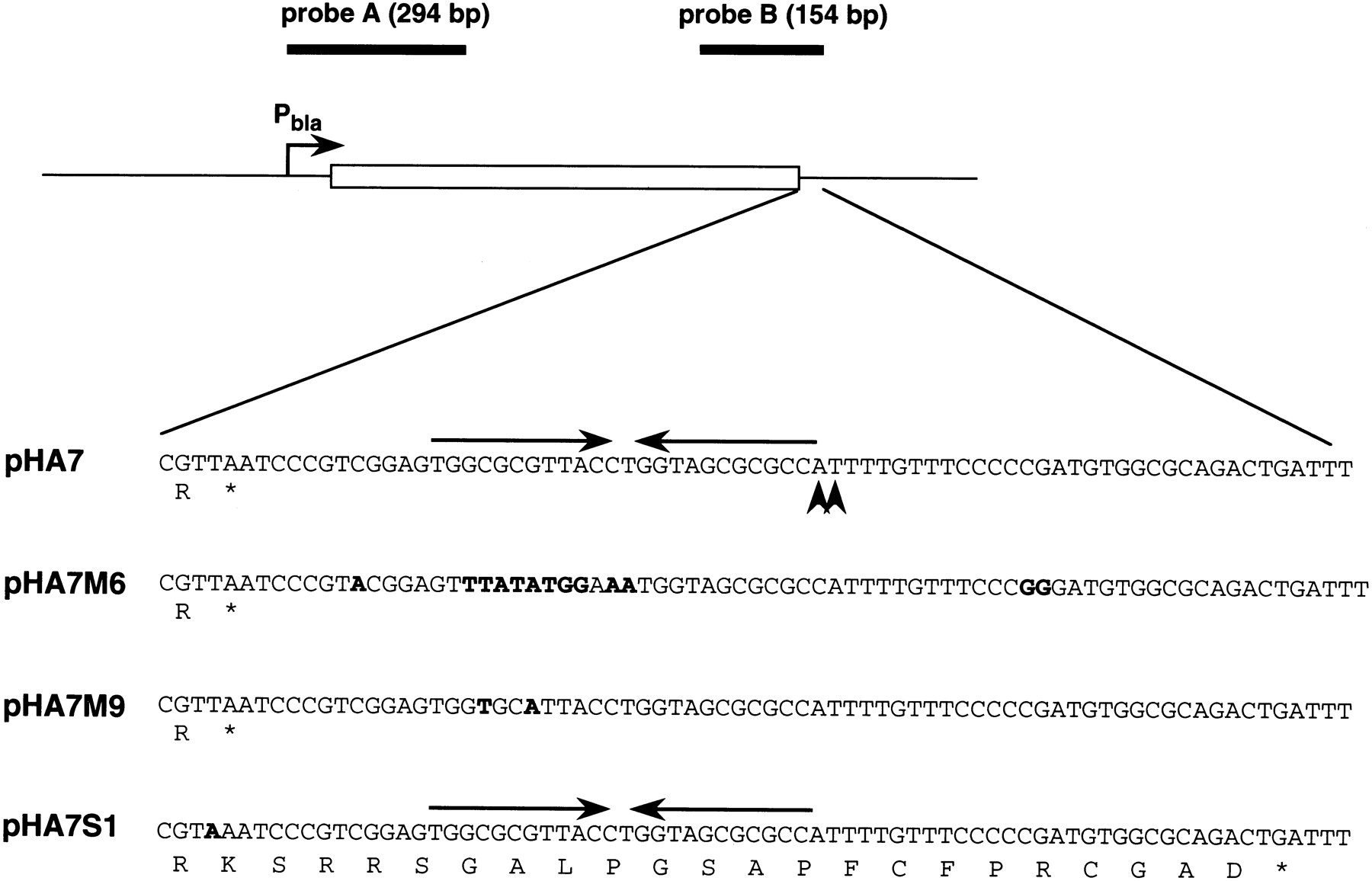
Sequences around the wild-type and variant crp terminators. Plasmid pHA7 carries the crp gene under the control of the bla promoter, whereas pHA7M6 and pHA7M9 are derivatives of pHA7 in which the terminator stem of crp is disrupted by base substitutions. Plasmid pHA7S1 is a derivative of pHA7 in which the crp stop codon (TAA) is changed to a sense cordon (AAA). (Upper panel) A diagram of the crp gene in these plasmids. The elevated arrow denotes the start and direction of transcription. The open rectangle represents the coding region for CRP. The black bars represent DIG-labeled DNA probes used for Northern analysis. The figure is not drawn to scale. The nucleotide sequences of the terminator region are shown below the diagram. The GC-rich inverted repeat sequence of the crp terminator is shown by horizontal arrows. The arrowheads indicate major 3′ ends of crp mRNA. The mutational changes are indicated as bold letters. Mutational changes outside of the hairpin structure in pHA7M6 are described previously and are not relevant to the present experiments. Asterisks indicate the translation termination codons. The amino acids encoded by the 3′-flanking region of crp are given below the nucleotide sequence.