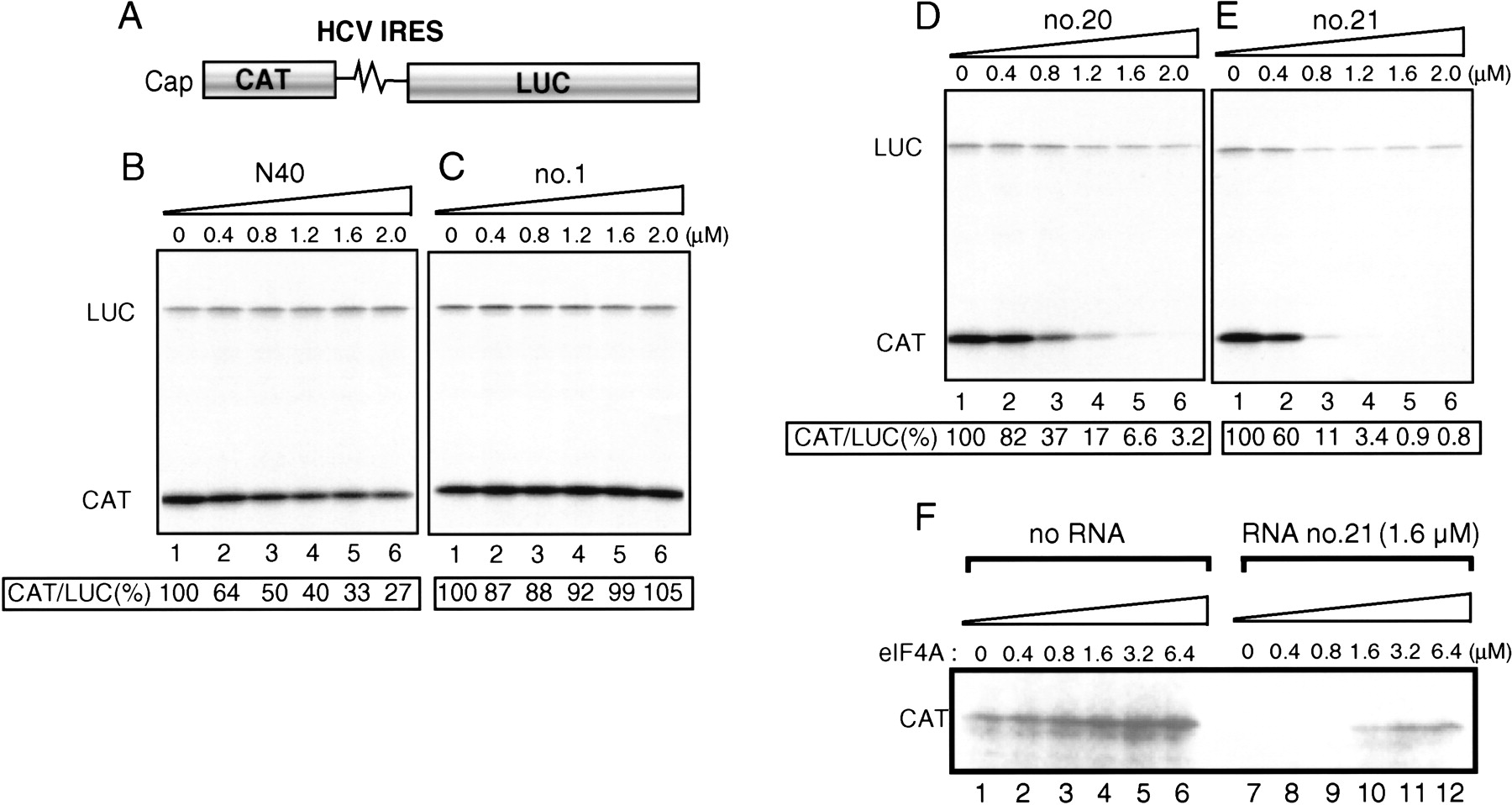
Inhibition of cap-dependent translation by RNA aptamers. (A) Schematic diagram of capped CAT/HCV/LUC mRNA. (B–E) Translation products of capped CAT/HCV/LUC mRNA in RRL. Reaction mixtures were pre-incubated at 30°C for 3 min with increasing amounts (0, 0.4, 0.8, 1.2, 1.6, and 2.0 μM in lanes 1–6, respectively) of N40 (B), no. 1 (C), no. 20 (D) and no. 21 (E) RNAs, followed by the addition of mRNA and [35S]methionine and further incubation for 60 min at 30°C. Products were analyzed by SDS-PAGE (15%) and fluorography. [35S]methionine incorporated into CAT and LUC are quantified using BAS-2000 Phosphorimager (Fuji Co.), and their relative values (CAT/LUC) are shown. The CAT/LUC ratio obtained in the absence of RNAs (lane 1, buffer control) was set as 100%. (F) Suppression of the inhibitory RNA action by exogenous eIF4A. Reaction mixtures were pre-incubated at 30°C for 3 min with increasing amounts of eIF4A (0, 0.4, 0.8, 1.6, 3.2, and 6.4 μM in lanes 1–6 or 7–12, respectively) in the presence (lanes 7–12) and absence (lanes 1–6) of RNA no. 21 (1.6 μM); followed by the addition of mRNA and [35S]methionine and further incubation for 60 min at 30°C.