


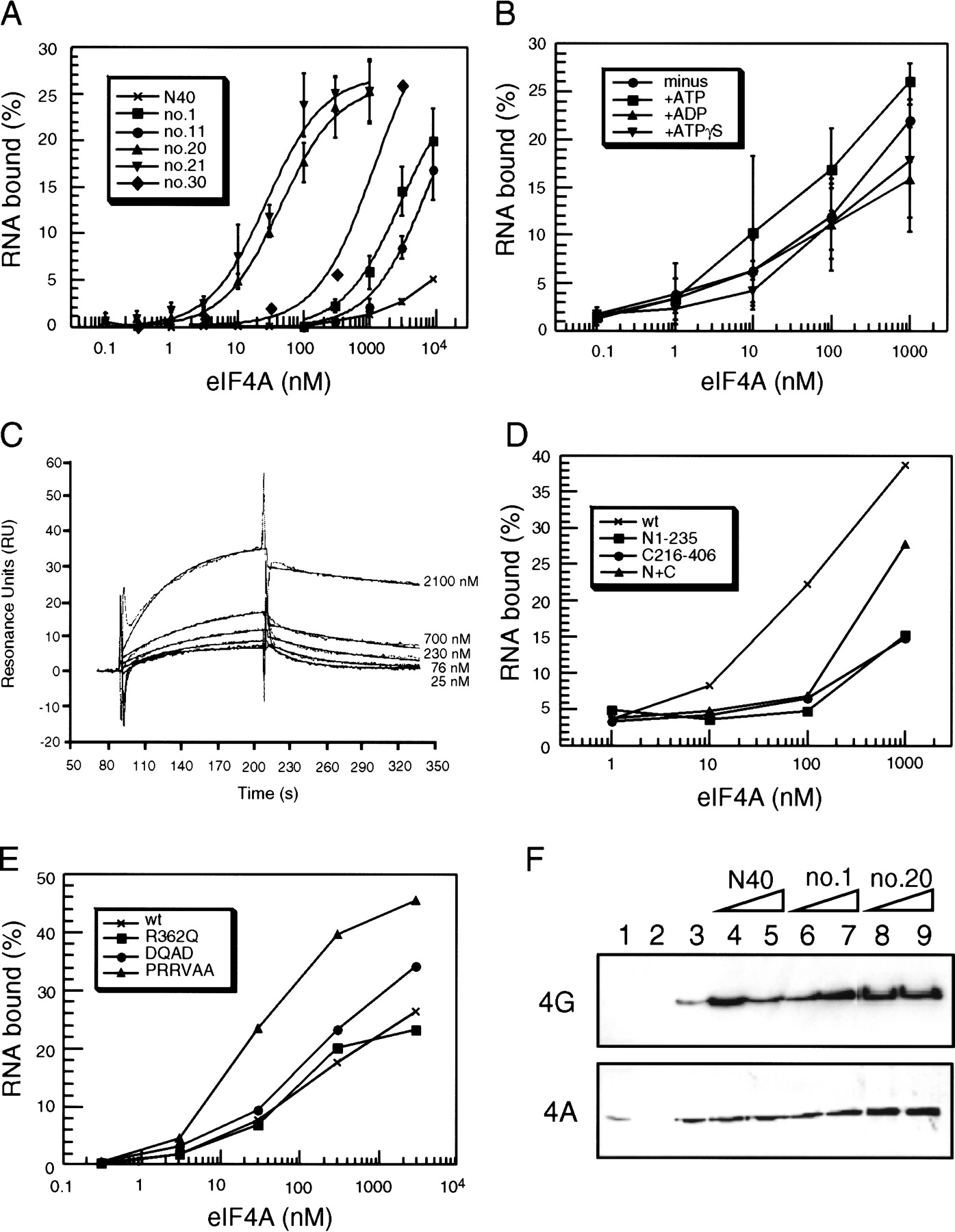
RNA-binding specificity of wild-type and mutant eIF4A proteins. Shown mostly is the percentage of input RNA that bound to the nitrocellulose filter with various concentrations of the selected RNAs. Experiments were performed independently at least three times and the values are expressed with or without standard deviations. (A) Nitrocellulose filter-binding assays of selected RNAs for wild-type eIF4A. (×) N40 random pool; (▪) no. 1; (•) no. 11; (▴) no. 20; (▾) no. 21; (♦) no. 30. (B) Binding affinity of RNA no. 20 in the absence (•) or presence of ATP (▪), ADP (▴) and ATPγS (▾). (C) Sensorgrams of RNA no. 21 binding to eIF4A. Each RNA sample with the indicated concentration was injected to the flow cells immobilized with wild-type eIF4A as well as to the control cell. Experimental details are described in Materials and Methods. (D) Nitrocellulose filter-binding assays of RNA no. 20 for eIF4A fragments. eIF4A samples: (×) wild-type; (▪) amino-terminal fragment N1–235; (•) carboxy-terminal fragment C216–406; (▴) N1–235 + C216–406. (E) Nitrocellulose filter-binding assays of RNA no. 20 for eIF4A mutants. eIF4A proteins: (×) wild-type; (▪) R362Q; (•) DQAD; and (▴) PRRVAA. (F) Pull-down assay of eIF4A and eIF4G613–1560 binary complex. Ni-NTA agarose resin conjugated with eIF4A (0.4 μM) was mixed with Flag-tagged eIF4G613–1560 (0.4 μM) in the presence of N40 and selected RNAs, and formed complexes were spun down. Bound eIF4G613–1560 and eIF4A were detected by Western blotting using anti-Flag antibody (upper panel) and by Coomassie staining (lower panel), respectively. Experimental details are described in Materials and Methods. Proteins: (lane 1) eIF4A alone; (lane 2) eIF4G613–1560 alone; (lanes 3–9) eIF4A plus eIF4G613–1560. RNAs: (lanes 1–3) none; (lane 4) N40 (2 μM); (lane 5) N40 (10 μM); (lane 6) no. 1 (2 μM); (lane 7) no. 1 (10 μM); (lane 8) no. 20 (2 μM); (lane 9) no. 20 (10 μM).




