


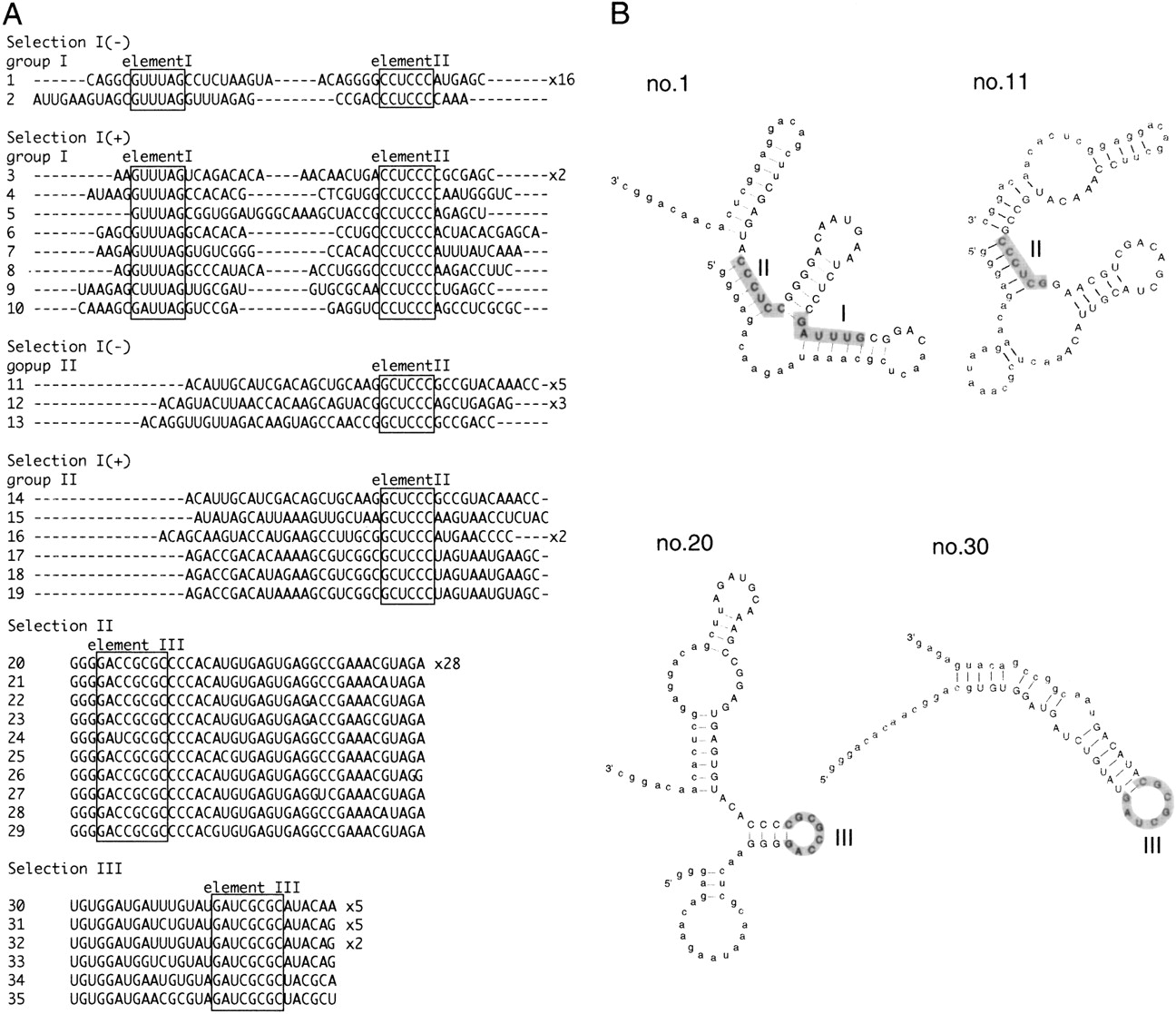
Selected RNA sequences with affinity for eIF4A. (A) Representative RNA sequences selected from randomized RNA libraries using different selection procedures. In selection I(+) and I(−), RNAs were selected from N40 pool in the presence and absence of ATP, respectively, via affinity precipitation with Ni-NTA agarose. Selection II and III used N40 and N30 pools, respectively, and RNAs were selected in the absence of ATP via nitrocellulose membrane trapping. The frequency of each sequence in these selections is shown as numbers of each clone found in 48 independent isolates. Boxed sequences indicate the consensus elements I, II, and III. According to consensus elements, RNAs in selection I are classified into two groups, group I and II. (B) Predicted secondary structures of certain RNA ligands selected by eIF4A. Selected sequences are shown in capital letters. Lowercase letters indicate the constant sequence regions flanking the random sequence. Conserved elements I, II, and III are shaded.




