


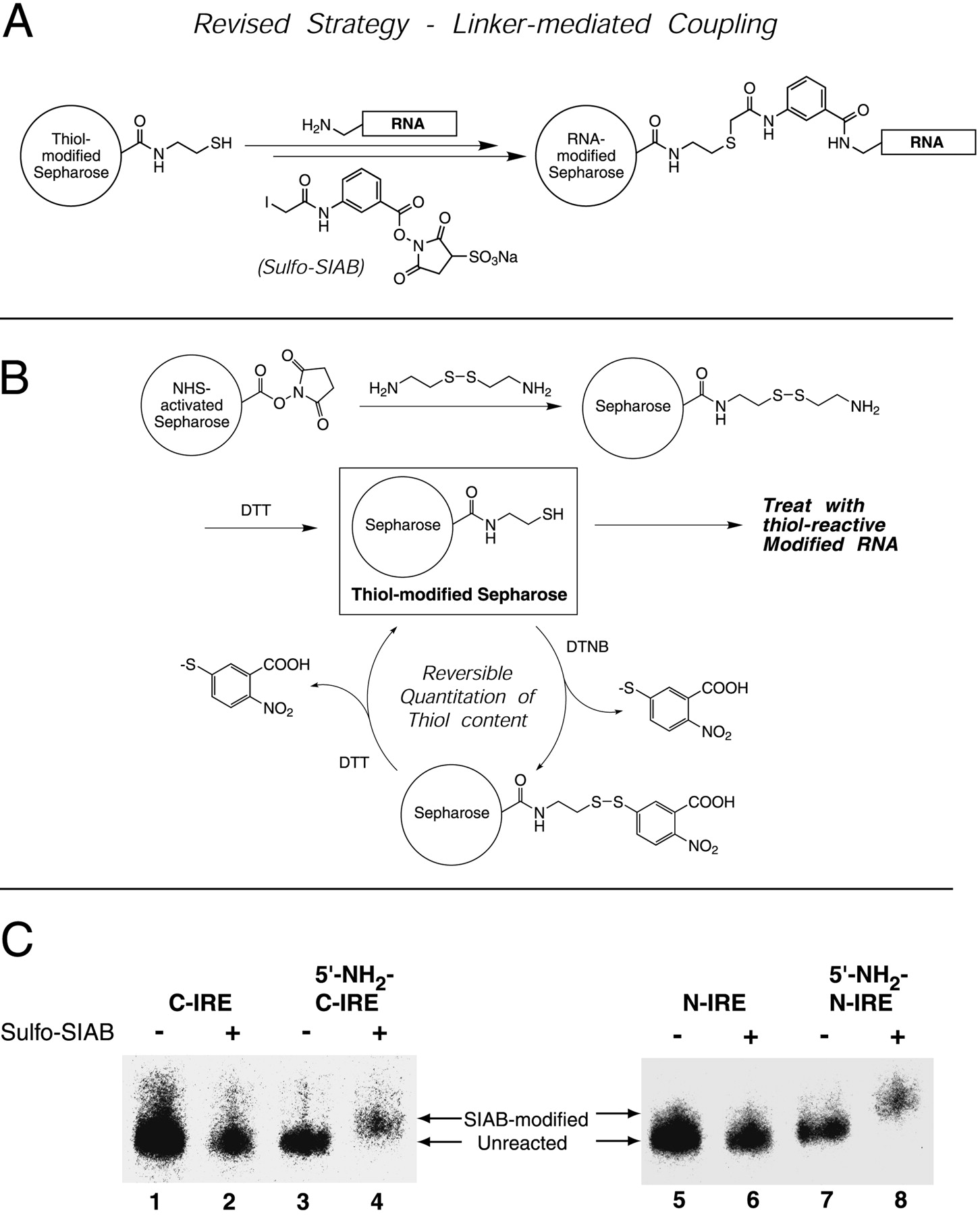
An alternative approach to covalent attachment of an alkylamine-modified RNA to an activated solid support. (A) This strategy utilizes a bifunctional linker (sulfo-SIAB) that bears an amine-reactive NHS-ester at one end and a thiol-reactive iodoacetamide group at the other. Starting with a thiol-modified solid matrix (Sepharose), a simple two-step procedure can be employed to covalently attach an alkylamine-modified RNA to the solid support. (B) One option for creating a thiol-modifed Sepharose is through the treatment of NHS-ester-activated Sepharose with the diamine cystamine. Subsequent reduction of the internal mixed disulfide with dithiothreitol produces the free-thiol. The yield of this reaction can be readily and reversibly measured through the treatment of the modified support with DTNB and measurement of the released chromophore at a wavelength of 412 nm. (C) The linker sulfo-SIAB reacts specifically and quantitatively with 5′-alkyamine modified RNAs (lanes 4,8). No reaction occurred between sulfo-SIAB and unmodified RNAs (lanes 2,6). Analysis is performed using 10% denaturing PAGE, 250 pmole of RNA per lane, and visualization by methylene blue.




