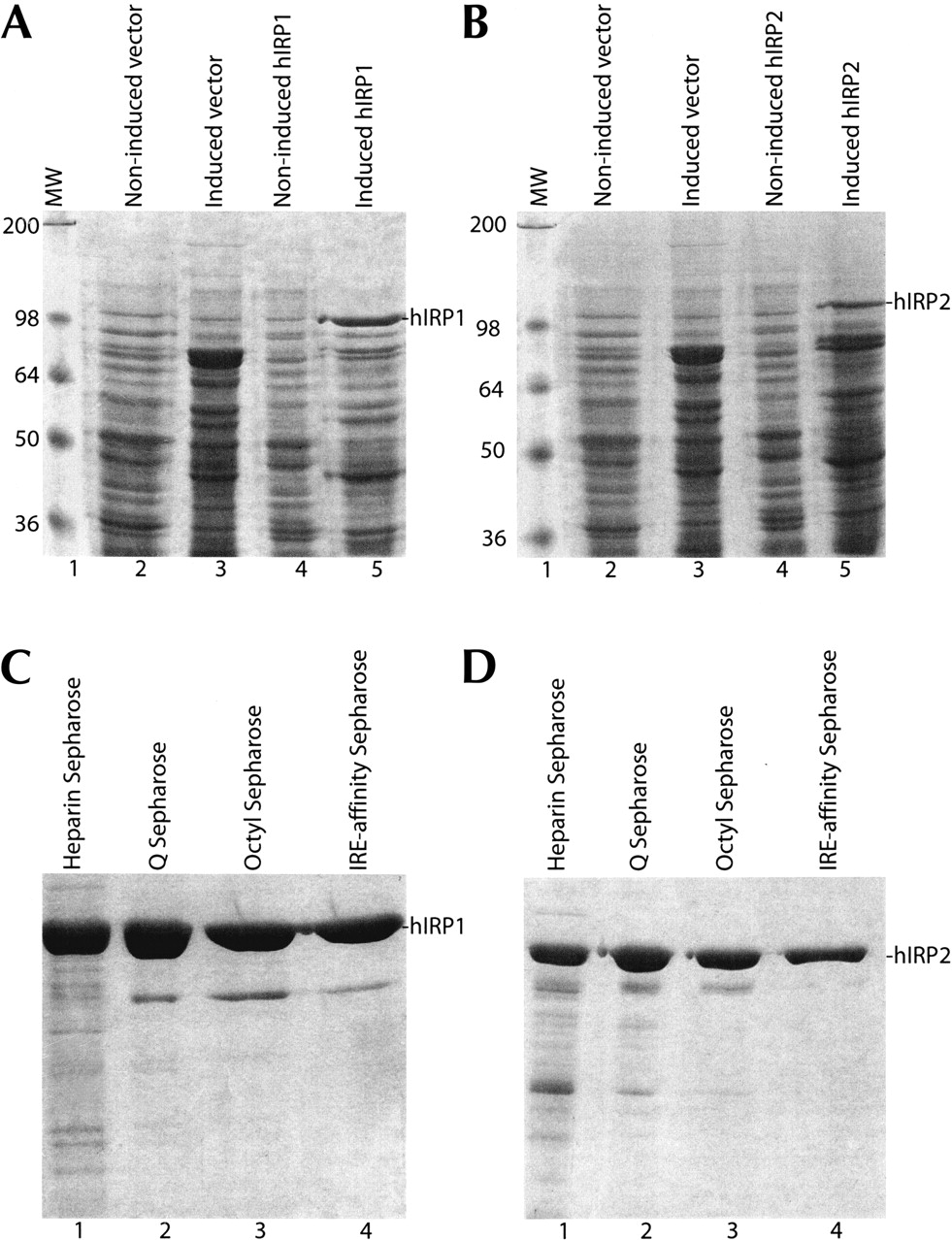

Unlabeled forms of both human IRP1 and human IRP2 were specifically and efficiently expressed in Pichia pastoris and purified to near homogeneity. (A) Comparison of lysates from yeast transformed with vector alone to those of yeast transformed with the IRP1-containing vector by 8% SDS-PAGE shows that despite their near identity in the absence of methanol induction (lanes 2,4), methanol induction of the IRP1-transformed yeast causes the appearance of a unique species (lane 5) with a molecular weight of the approximately correct mass for IRP1 (∼98 kD). (B) A similar comparison of vector-transformed and IRP2-vector transformed yeast also highlights the appearance of a unique species (lane 5) with an apparent molecular weight that closely matches the expected mass of IRP2 (∼104 kD). (C) The purification of IRP1 from P. pastoris lysates through a series of four chromatographic columns (Heparin Sepharose, lane 1; Q Sepharose, lane 2; Octyl Sepharose, lane 3; and preparative IRE-affinity Sepharose, lane 4) yielded a nearly homogeneous protein preparation as determined by Coomassie-stained SDS-PAGE. The band appearing at ∼75 kD may correspond to a nicked form of IRP1 that fragments upon denaturation onto the gel (data not shown). (D) The purification of IRP2 from lysates through an identical procedure also yields protein of very high purity, especially following preparative IRE-affinity chromatography. Each lane of C and D contained approximately 4 μg of total protein (as determined by BCA assay). (E,F) Analyses of IRP1 (E) and IRP2 (F) purification identical to those depicted in C and D, respectively, except that silver staining was used to visualize the protein and less protein was used per lane.