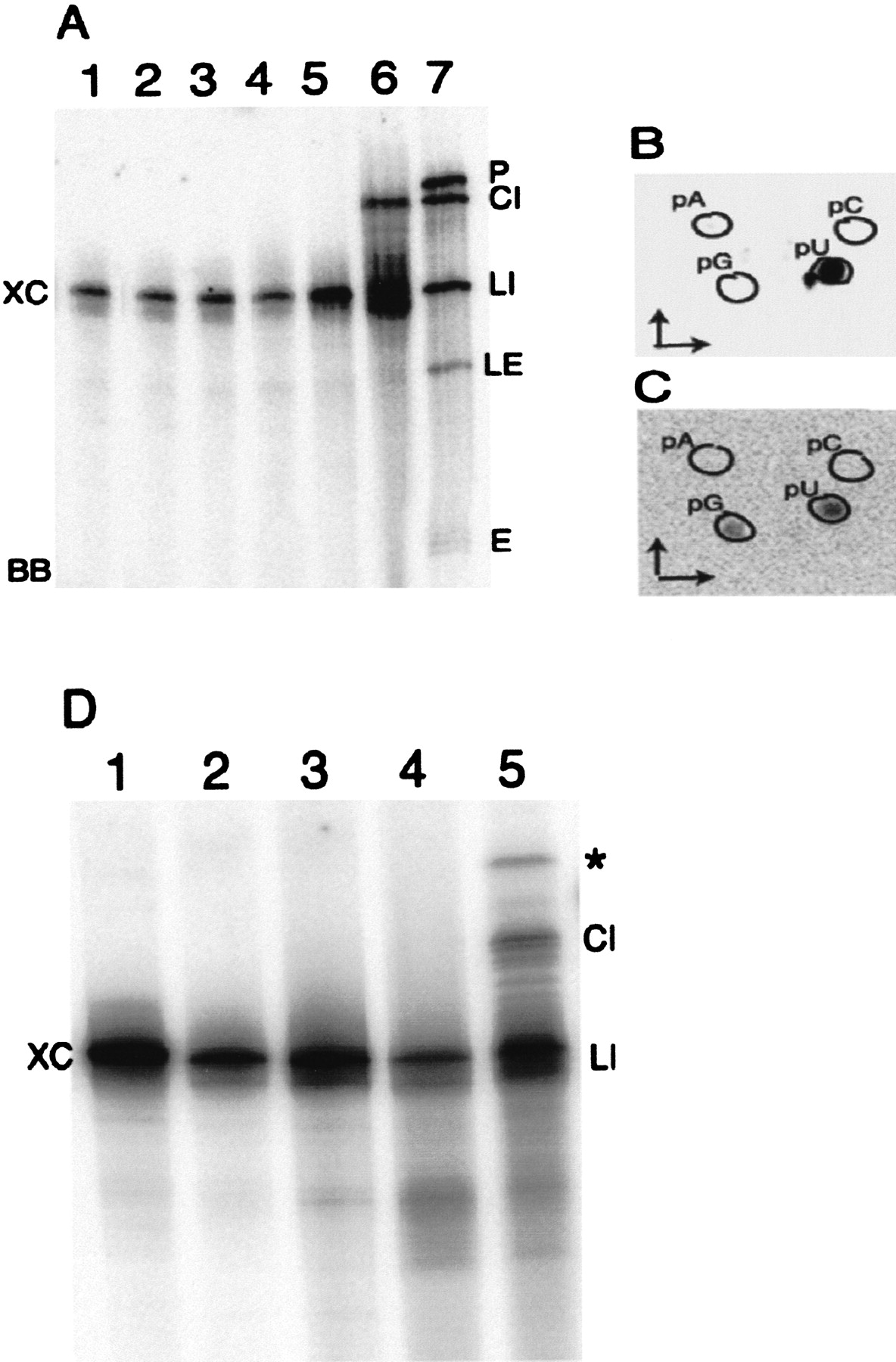
Ligation of synthetic intron-like transcripts. (A): [α-32P]UTP-labeled synthetic tRNATrp intron transcripts are modified to create proper termini and then used as substrate for the ligase reactions. The products are analyzed on a denaturing 8% polyacrylamide gel. Lane 1, transcript; lane 2, dephosphorylated transcript; lane 3, dephosphorylated transcript after periodate oxidation and amine cleavage; lane 4, ligase reaction using substrate shown in lane 3; lane 5, substrate shown in lane 3 treated with RNA 3′ terminal phosphate cyclase; lane 6, ligase reaction using substrates shown in lane 5; lane 7, standard ligase reaction using endonuclease treated pre-tRNATrp as substrate. (LI) Linear intron and intron-like substrate; (CI) circular RNA; (P) precursor; (E) exons; (LE) ligated exons; (XC) xylene cyanol; (BB) bromophenol blue. Gel-eluted products from A are digested with nuclease P1 and separated by TLC in B (LI, lane 1) and C (CI, lane 6) using solvent a in the first dimension and solvent c in the second dimension. Outlines indicate the positions of nonradioactive markers in B and C. (The labeled spot near pU in B is derived from an unidentified contaminant present in [α-32P]UTP; see Materials and Methods.) (D) Synthetic intron transcripts similar to those in A with a specific CC-to-AA change (Fig. 1C) were used for ligation reactions like those shown in A. Lane 1, transcript; lane 2, dephosphorylated transcript; lane 3, dephosphorylated transcript after periodate oxidation and amine cleavage; lane 4, substrate shown in lane 3 treated with RNA 3′ terminal phosphate cyclase; lane 5, ligase reaction using substrates shown in lane 4. Ligated dimer of the substrate is indicated by an asterisk in D.