


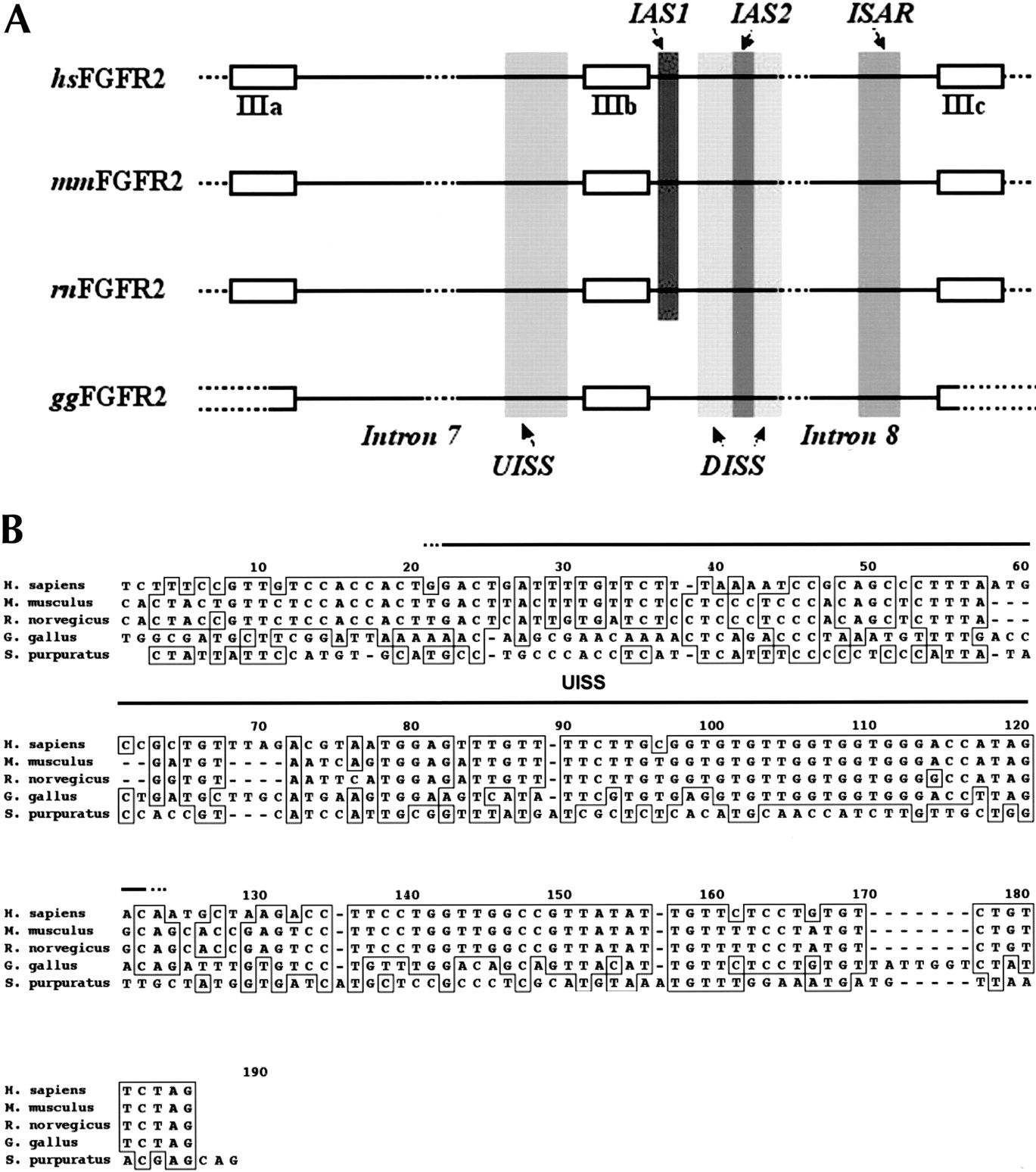
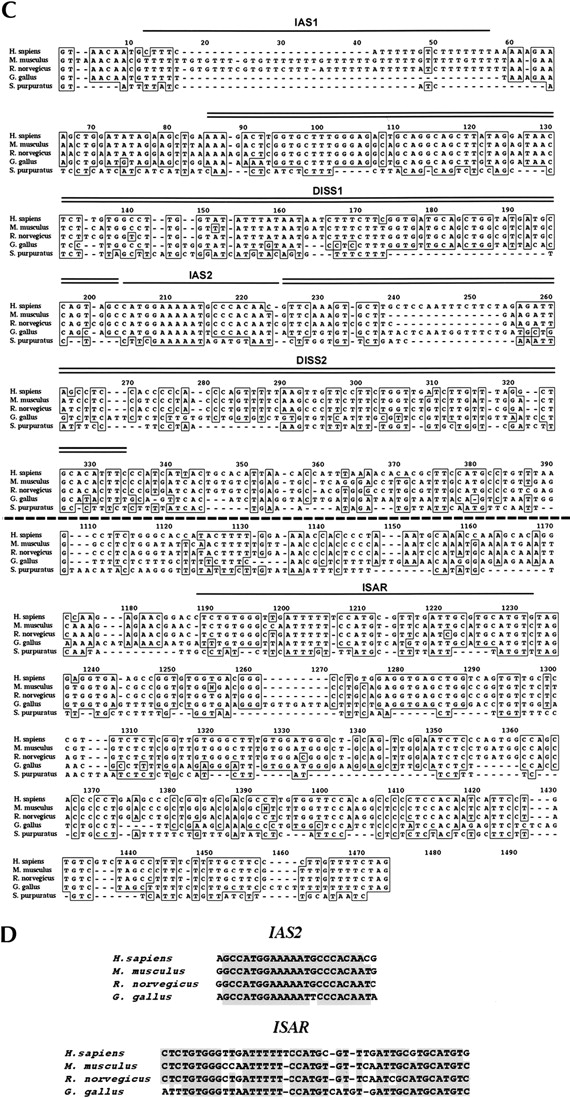
The IgIII alternative splicing unit in vertebrate FGF-R genes is highly conserved. (A) A schematic diagram of the genomic region spanning the IgIII alternative splicing unit is shown for human (hsFGF-R2), mouse (mmFGF-R2), rat (rnFGF-R2), and chicken (ggFGF-R2) FGF-R2 genes. Exons IIIa, IIIb, and IIIc, and introns 7 and 8 are indicated, and the nomenclature is based on the structure of the gene in mammals. ClustalW alignments revealed high conservation of sequence in the regions indicated in the figure: the upstream intronic splicing silencer (UISS), the downstream intronic splicing silencer (DISS), the intronic activation sequence-2 (IAS2), and the intronic splicing activator and repressor (ISAR)(also known as IAS3). Broken lines in exons IIIa and IIIc of ggFGF-R2 represent regions where sequence has not been rigorously confirmed. (B) A ClustalW alignment of the 3′ end of intron 7 from vertebrate FGF-R2 and spFGF-R genes revealed conservation of UISS among vertebrates. (C) A ClustalW alignment of intron 8 from vertebrate FGF-R2 and spFGF-R genes shows the remarkable conservation of cis-acting elements, most notably IAS2 and ISAR. Divergent sequences in the middle of the intron are not shown. (D) Sequence alignment revealed high conservation within the IAS2 and ISAR regulatory elements among the four vertebrate species.




