


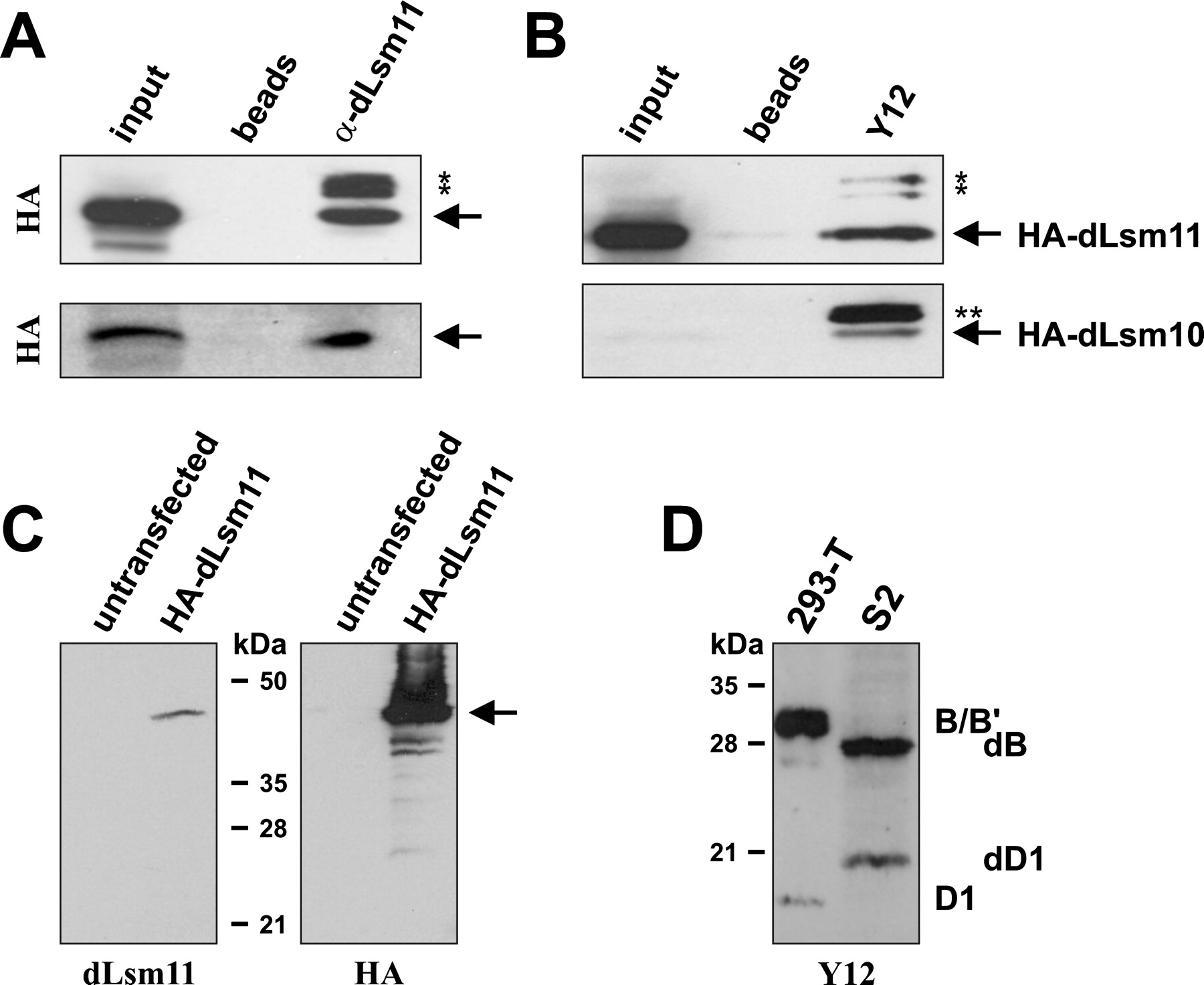
In vivo association of Drosophila Lsm10 and Lsm11 with each other and with Sm proteins. (A) Immunoprecipitation by an affinity-purified antibody raised against recombinant GST-tagged dLsm11 (α-dLsm11). Drosophila S2 cells were transiently transfected with expression plasmids encoding HA-tagged dLsm11 (top) or dLsm10 (bottom), and whole-cell extracts were subjected to immunoprecipitation, SDS-PAGE, and Western blotting with anti-HA antibody. Input indicates sample of nuclear extract prior to immunoprecipitation; beads, control precipitation by protein G–Sepharose beads without antibody. Asterisks (*) indicate bands of slower electrophoretic mobility that react with the anti-HA antibody subsequent to immunoprecipitation; it is not known whether these represent potentially modified HA-dLsm11 protein (the expected reacting band is indicated by an arrow). (B) Immunoprecipitation of nuclear extracts from similar transfections by monoclonal anti-Sm antibody Y12. Lane labels and symbols are used as in A. (C) Reactivity of the anti-dLsm11 antibody used in A. Duplicate samples of whole-cell extracts from untransfected Drosophila S2 cells or cells stably expressing HA-dLsm11 were subjected to SDS-PAGE and blotted onto the same filter. The two filter halves were probed with either anti-dLsm11 or anti-HA antibodies as indicated below the panels. Both antibodies react with a protein of identical electrophoretic mobility representing HA-dLsm11 (arrow). (D) Reactivity of the anti-Sm antibody Y12 used in B Nuclear extracts from human 293-T cells and from Drosophila S2 cells were subjected to SDS-PAGE and Western blotting with Y12 antibody. The antibody reacts primarily with human Sm B/B′ and D1 and with their corresponding Drosophila orthologs.




