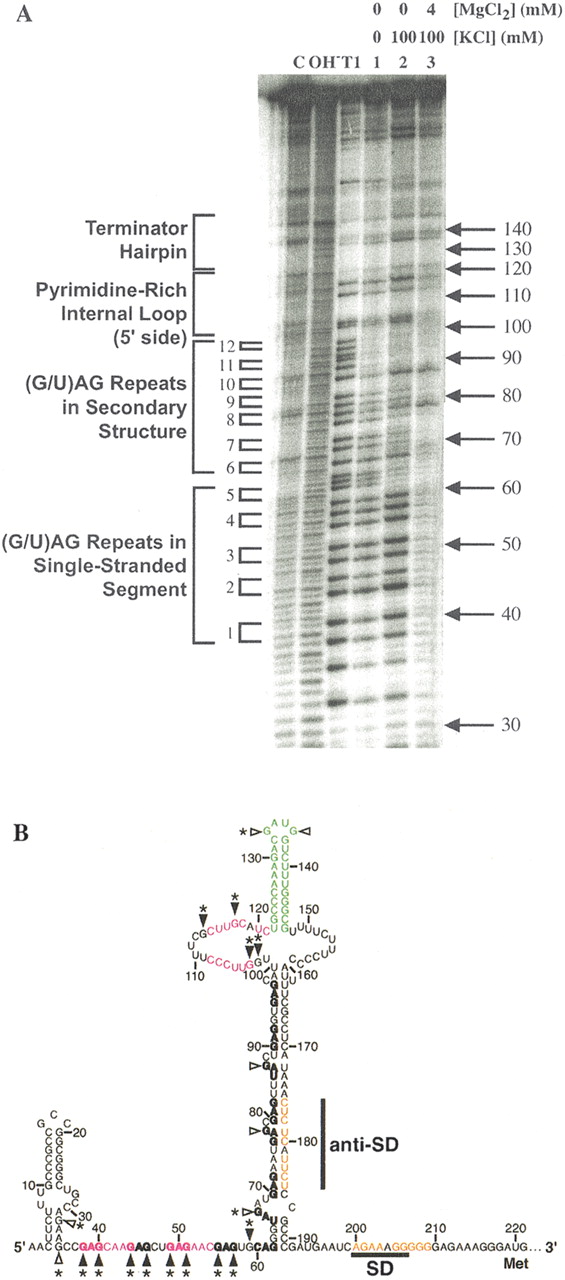
Ion dependence of B. stearothermophilus trp leader RNA structure formation. (A) 5′ 32P-labeled RNA (1–232) was subjected to partial RNase T1 digestion to probe RNA structure under various salt conditions. C is the untreated RNA, OH− is a limited alkaline hydrolysis ladder, and T1 is a limited RNase T1 digest under RNA denaturing conditions. Lane 1, RNA renatured in TK0M0; lane 2, RNA renatured in TK100M0; lane 3, RNA renatured in TK100M4. Important secondary structural features are given on the left side of the gel, including triplet repeat number. (B) Sites of RNase T1 cleavage superimposed on the secondary structure. Filled and open triangles indicate sites of strong and weak cleavage, respectively, in TK100M0. Asterisks (*) indicate sites of reduced cleavage upon the addition of 4 mM Mg2+. Numbering is from the start of transcription.