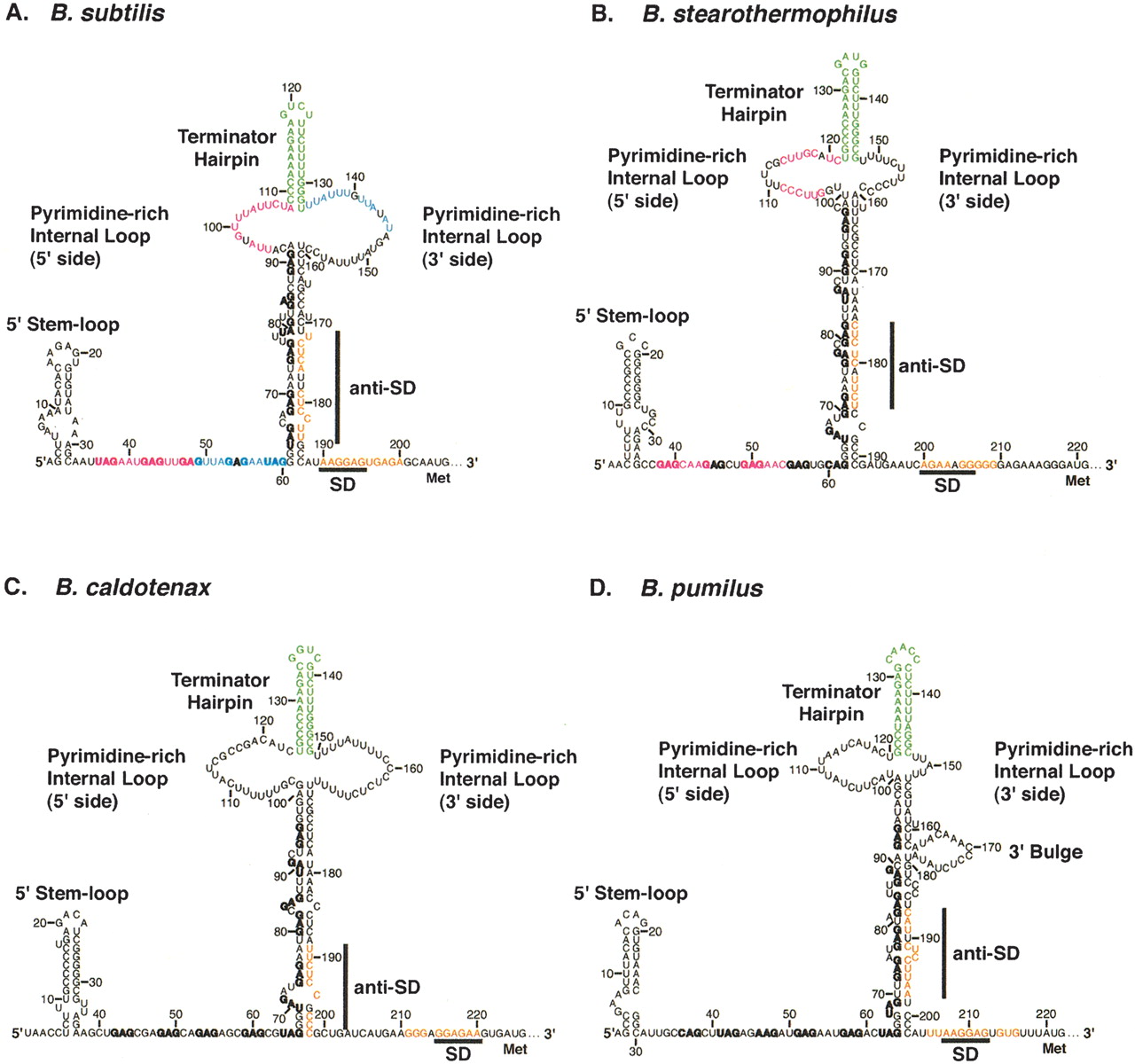
Comparison of trp leader RNA secondary and tertiary structures for (A) B. subtilis, (B) B. stearothermophilus, (C) B. caldotenax, and (D) B. pumilus. Conserved primary and secondary structural features include a 5′ stem–loop, 11 or 12 NAG triplet repeats (bold), a terminator hairpin (green), an anti-SD sequence that is capable of sequestering the trpE SD sequence (orange), and a pyrimidine-rich internal loop and/or bulge. In addition, each leader is predicted to form a long-range tertiary interaction between a pyrimidine-rich internal loop and/or bulge and the single-stranded triplet repeats. Identically colored interacting segments (magenta or blue) are shown for B. subtilis and B. stearothermophilus. A weak interaction of nt 55–59 and the 3′ side of the pyrimidine-rich internal loop may also occur for B. stearothermophilus (see text), although its register is uncertain and therefore not shown. The base-pairing details for the tertiary structures have been worked out for B. subtilis (Schaak et al. 2003) and B. stearothermophilus (this report); however, formation of the tertiary structure has not been examined in B. pumilus or B. caldotenax, and the register of base-pairing is uncertain.