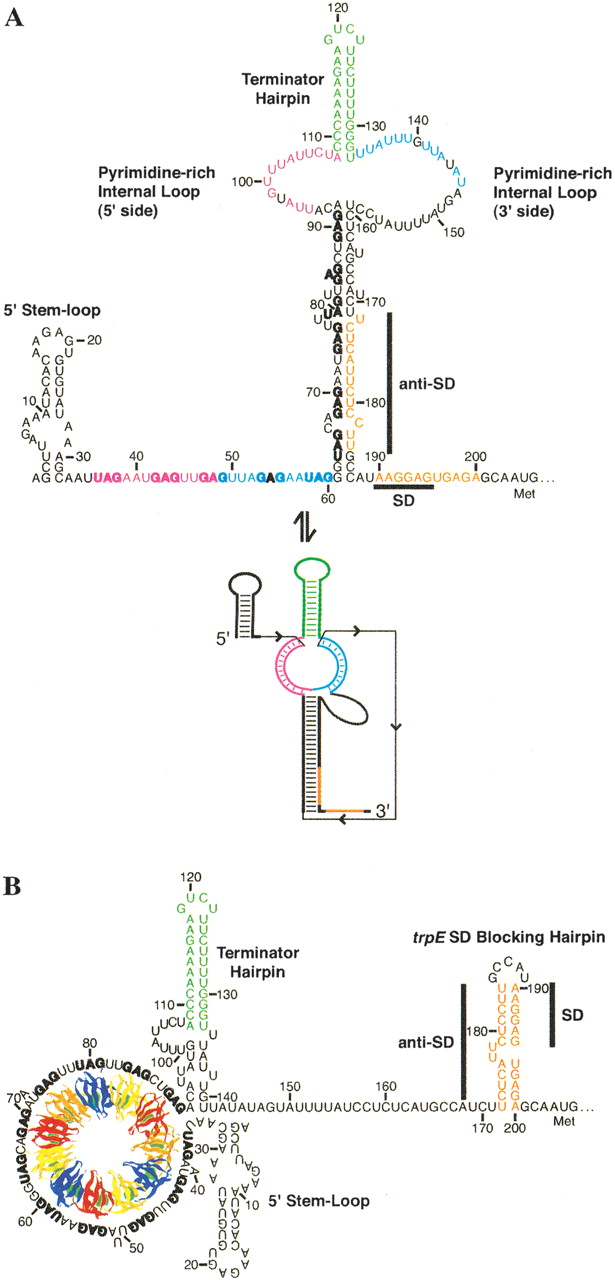
Model of the trpE translation control mechanism. (A) In the absence of TRAP binding, trp operon readthrough transcripts can adopt a secondary structure in which the trpE SD sequence is single-stranded and available for ribosome binding. This secondary structure was predicted from mfold v3.1 using experimental constraints determined herein. The tertiary structure model (lower structure) predicts that 24 nt in the 5′ (magenta) and the 3′ (blue) sides of the pyrimidine-rich internal loop base pair with the same colored residues between nt 33 and 60 containing the single-stranded (G/U)AG repeats (the secondary structure defects are omitted for clarity; Schaak et al. 2003). (B) When TRAP binds to trp operon readthrough transcripts, a structural rearrangement occurs in the RNA such that the trpE SD sequence becomes sequestered in a stable hairpin (trpE SD blocking hairpin) by pairing with the anti-SD sequence. Formation of this structure inhibits ribosome binding. The (G/U)AG repeats are shown in bold type; the sequences involved in the trpE SD blocking hairpin are shown in orange; the terminator hairpin that forms in trp operon readthrough transcripts is shown in green. Numbering is from the start of transcription.