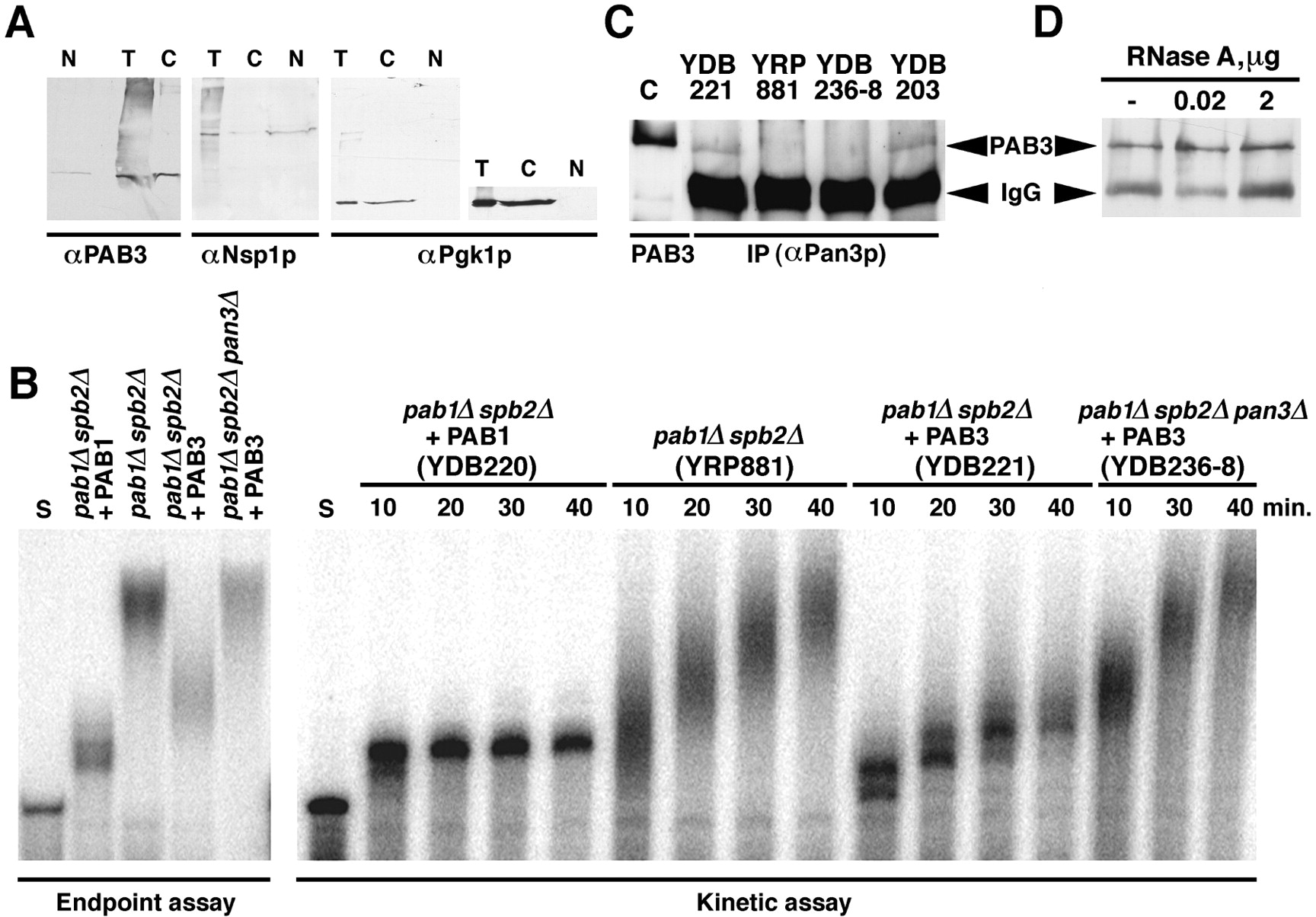
Evidence that PAB3 functions in the nucleus in yeast. (A) Results of the subcellular fractionation of the extract of the PAB3-complemented yeast strain YDB203. Equivalent amounts of the total unfractionated extract (T), as well as the nuclear (N) and cytoplasmic (C) fractions were immunoblotted and probed for PAB3, Nsp1p (nuclear marker) and Pgk1p (cytoplasmic marker). Overexposure of the immunoblotting for Pgk1p is shown at right to demonstrate the absence of the cytoplasmic contamination in the nuclear fraction. (B) Results of the endpoint (left) and kinetic (right) polyadenylation assays in vitro using the precleaved substrate. Relevant genotypes of the strains from which the extracts were prepared are shown at top. Lanes marked S contain the precleaved substrate RNA only. (C) PAB3 copurifies with the yeast Pan3p in a coimmunoprecipitation assay. Extracts from the yDB221 (pab1Δ spb2Δ + PAB3), yDB236-8 (pab1Δ spb2Δ pan3Δ + PAB3), and YDB203 (PAN3 strain complemented by PAB3) cells were incubated with the antiPan3p antiserum immunoprecipitates captured on protein A agarose, extensively washed, and the bound material immunoblotted for PAB3. Recombinant PAB3 was loaded in the leftmost lane (marked C) as a positive control. Positions of the signals corresponding to PAB3 and IgG heavy chain are indicated by arrowheads. (D) Communoprecipitation of PAB3 and Pan3p from YDB203 extracts is resistant to treatment with 0.02–2 μg of RNase A for 40 min at room temperature.