


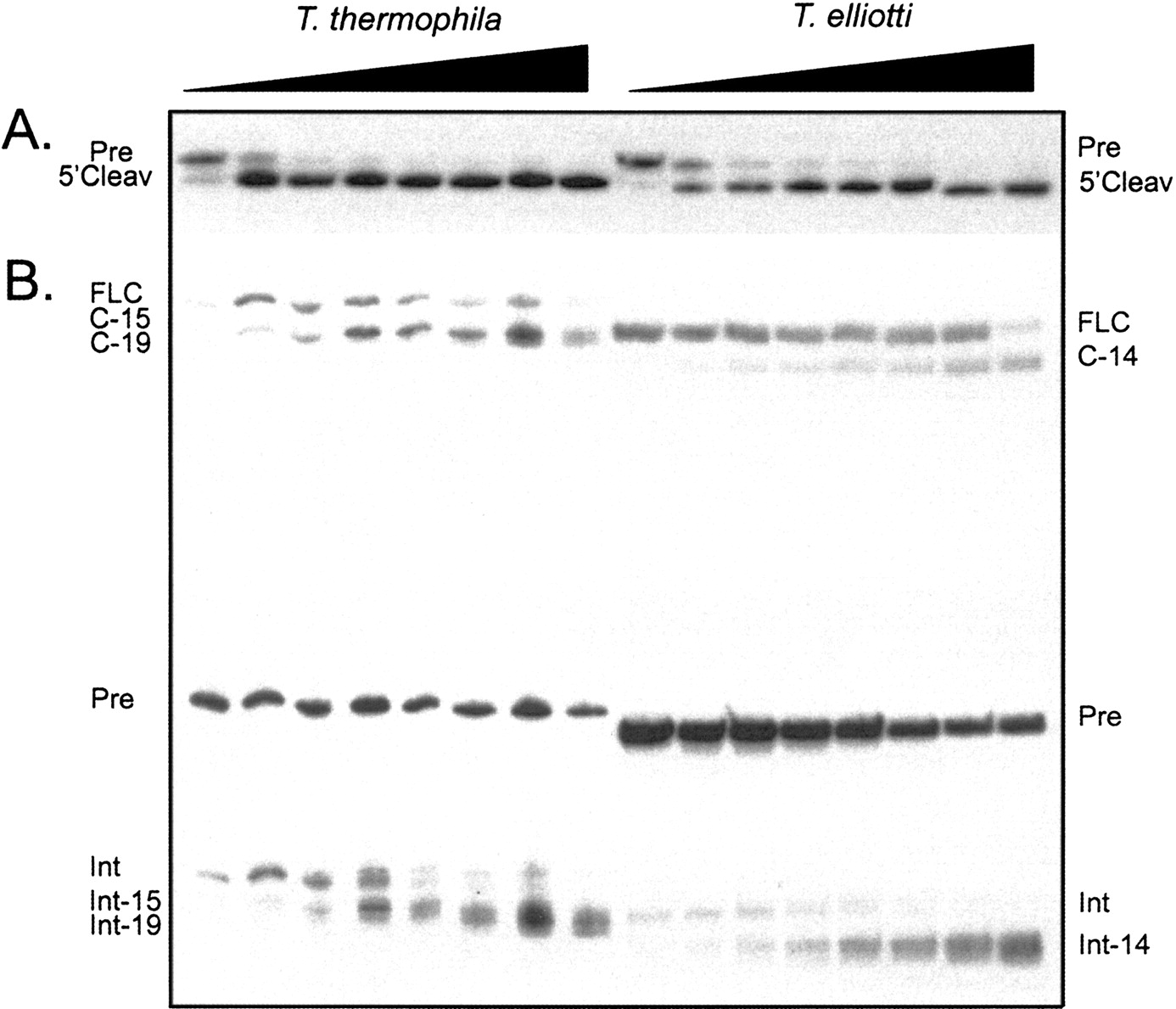
Hydrolysis at the 3′ SS and circularization of Tetrahymena introns. The two steps of the circularization pathway were analyzed independently in homologous introns from two different Tetrahymena species (T. thermophila and T. elliotti). (A) Intron transcripts lacking P1 (and consequently the 5′ SS) were analyzed for the 3′-SS hydrolysis step of the reaction. (B) Intron transcripts that include the 5′ exon, but terminate exactly at the ωG, were analyzed for the circularization step of the reaction. All the experiments were performed as a time-course experiment (0, 2, 5, 10, 15, 30, 60, 120 min) using standard splicing conditions and the RNAs analyzed on either 8 M urea/6% polyacrylamide gels (A) or 8 M urea/4% polyacrylamide gels in 0.4× TBE buffer (B). The positions in the gel of the various RNAs from T. thermophila and T. elliotti are indicated to the left and right, respectively. For example, C-15 and Int-15 refer to circular and linear intron species lacking 15 nt at the 5′ terminal. The identity of the circular species were verified by gel purification, RT-PCR, and sequencing (data not shown).




