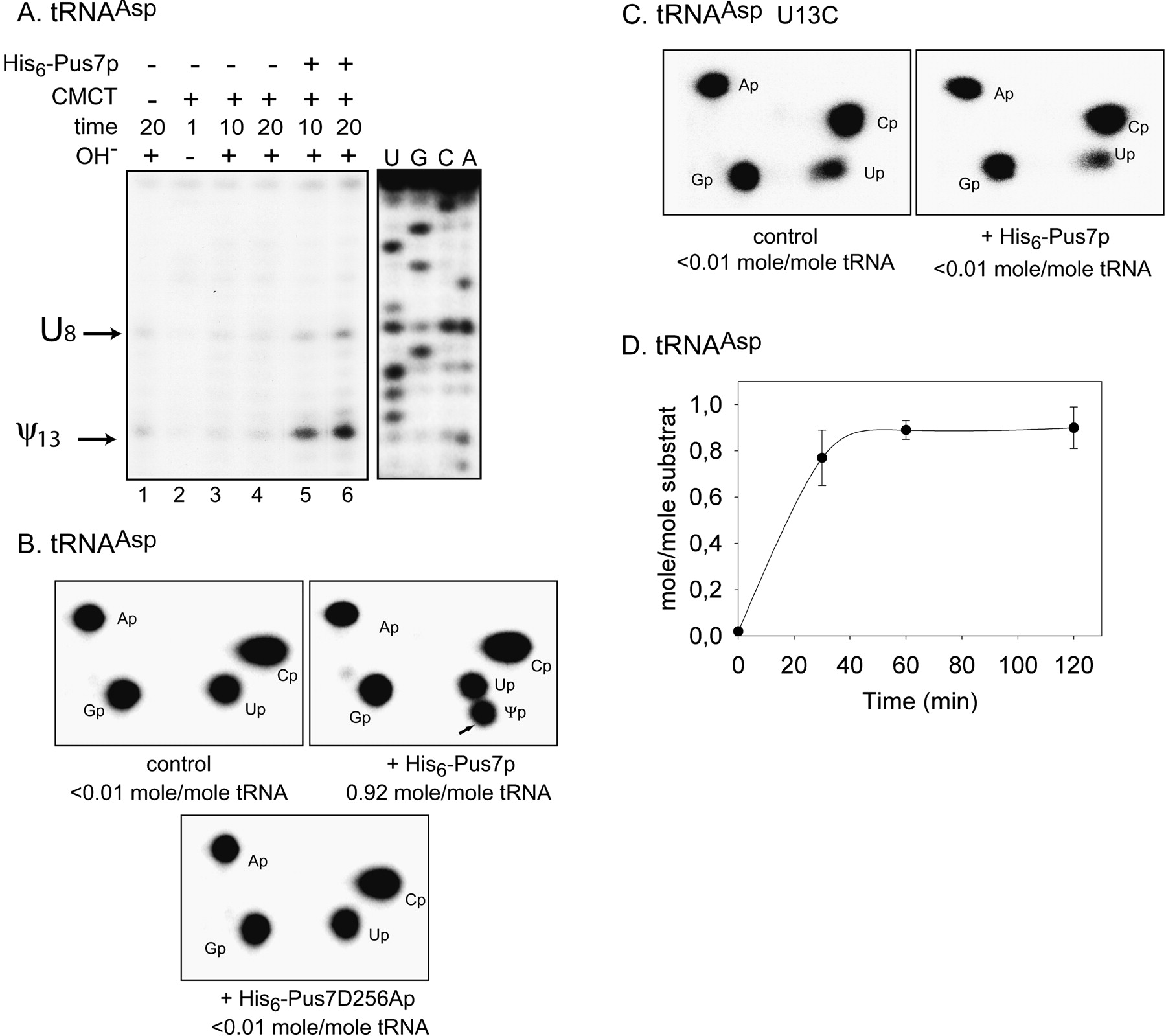
Recombinant His6–Pus7p catalyzes specifically U to Ψ conversion at position 13 in yeast cytoplasmic tRNAAsp. (A) CMCT/RT mapping of Ψ residues formed upon incubation of tRNAAsp with His6–Pus7p. Cold in vitro produced tRNAAsp was incubated in the presence (+) or absence (−) of His6–Pus7p in the conditions described in Materials and Methods. The modified tRNAAsp was analyzed by the CMCT/RT approach (same legend as in Fig. 3). (B) Analysis of Ψ13 formation in tRNAAsp by the nearest neighbor approach. tRNAAsp transcript labeled with [α-32P]ATP was incubated with the recombinant His6–Pus7p or the His6–Pus7D256Ap mutant in the conditions described in Materials and Methods. A control incubation was performed in the absence of the recombinant protein. The incubated tRNAsAsp were digested with T2 RNase and the released 3′NMPs were fractionated by TLC, as described in Materials and Methods. The autoradiograms of the TLC plates are shown. The molar ratio of Ψ residues formed in tRNAs, as deduced from quantification of the radioactivity of the spots, is given at the bottom of the panels. (C) Same experiment as in (B) with the U13C variant tRNAAsp. (D) Time-course analysis of tRNAAsp modification by the recombinant His6–Pus7p enzyme. tRNAAsp transcript (50–100 fmoles) was incubated with 750 fmoles of His6–Pus7p in the conditions described in Materials and Methods. Aliquot fractions were collected at the indicated times after the beginning of the incubation. For each fraction, RNA was digested with T2 RNase and the released products were analyzed by 2D TLC. Confidence intervals are calculated taking into account the relative radioactivity measured for the ΨMP spot and the Ap, Cp, Gp, and Up spots on 2D TLC.