


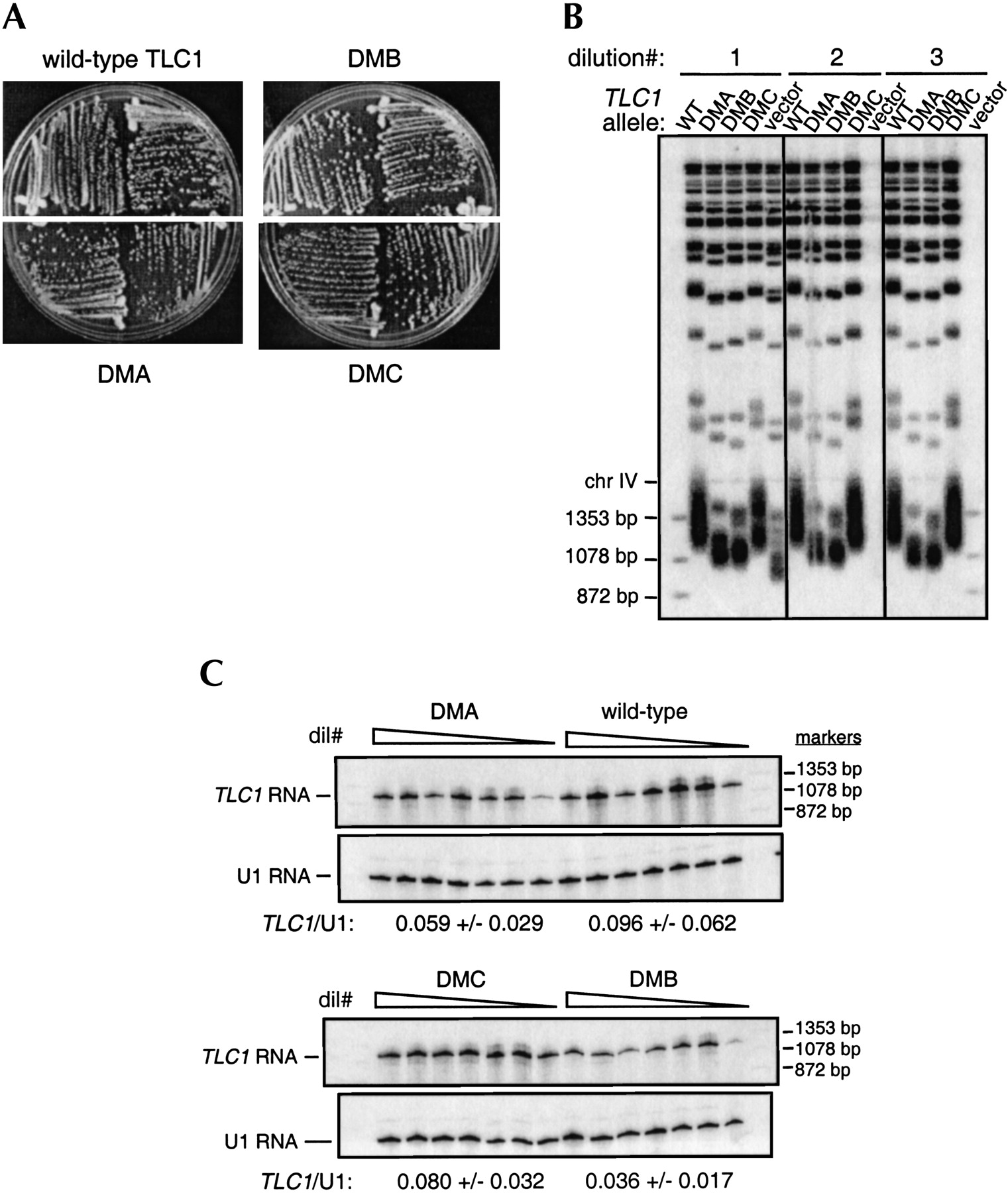
Analysis of growth, telomere lengths, and telomerase RNA levels of pairing element disruption mutants. (A) Growth of DMA, DMB, and DMC mutants compared with wild-type TLC1. DMA, DMB, DMC, wild-type TLC1, and an empty vector were transformed into a tlc1Δ rad52− strain complemented with wild-type TLC1 on an LYS2 plasmid. After loss of the complementing wild-type TLC1 plasmid by growth on α-aminoadipate, a single colony of each strain was restreaked to selective media. This senescence assay was carried out for nine restreaks, corresponding to ~225 generations. By the ninth restreak (shown), no senescence is observed. (B) Telomere length analysis of DMA, DMB, and DMC mutants compared with wild-type and empty vector. Strains were generated as described for A. After loss of the complementing wild-type TLC1 plasmid, a single colony was picked into liquid culture, diluted 200-fold, then regrown to saturation. Four successive serial dilutions were performed. Genomic DNA was prepared from each saturated culture, corresponding to ~42 generations in total, digested with XhoI to release terminal telomeric restriction fragments, resolved on an agarose gel, and analyzed by Southern blotting with probes to telomeric sequence and a region of Chromosome IV (chr IV). The markers shown were radiolabeled [phis]X174-HaeIII-digested DNA fragments. (C) Telomerase RNA levels of DMA, DMB, and DMC mutants. Single colonies of DMA, DMB, DMC, and wild-type TLC1 were picked into liquid culture and serially diluted seven times, as described for B, corresponding to ~98 generations of growth. Total RNA was prepared from these cultures and separated on a 4% PAGE-7 M urea gel and Northern blotted; RNAs were visualized by hybridization with random-primed DNA probes to full-length TLC1 and U1 RNAs. Telomerase RNA levels were quantitated by PhosphorImager analysis. The TLC1 RNA signal was normalized to the U1 RNA signal in each lane. The mean of the TLC1/U1 ratios for the seven dilutions and its standard deviation are reported below each mutant analyzed.




