


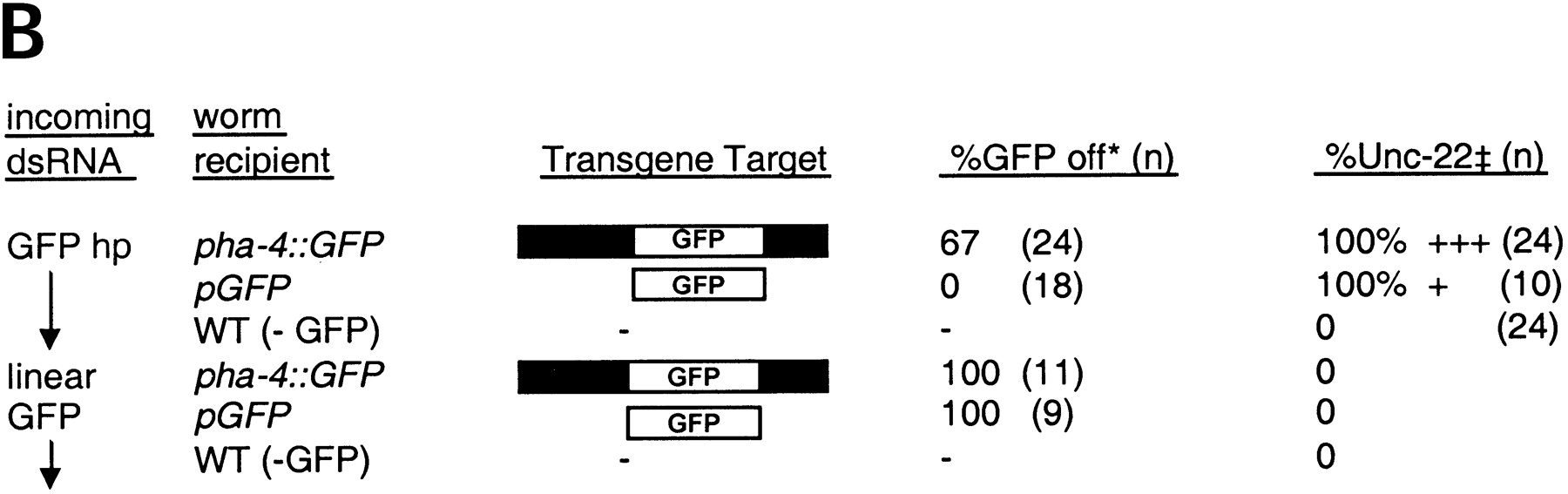
Two models for RNAi with loop sequences of a dsRNA hairpin. (A) GFPhp is a dsRNA hairpin with GFP sense RNA(s) on the 5′ end of the stem and GFP antisense RNA (as) on the 3′ end of the stem; unc-22 sequences are located in the loop (Winston et al. 2002). The hairpin is predicted to undergo processing to form siRNAs, with the last fragment of dsRNA bearing the unc-22 loop. Association of siRNAs with the GFP mRNA will induce endonucleolytic cleavage of the target. Cleaved GFP mRNA may function as a primer to synthesize a complementary strand of unc-22 RNA using the loop-containing siRNA as template (1, left). Alternatively, siRNAs generated during GFP RNAi may prime dsRNA synthesis with a new GFPhp (2, right). (B) Silencing of GFP and unc-22. (*) Percentage of animals with GFP completely off. (‡) Percentage of uncoordinated animals. (+++) Animals that were paralyzed on the plate; (+) animals that were sluggish or egg-laying defective. pGFP is not silenced effectively by GFPhp feeding, but presumably some RNAi is occuring since this strain was tested concurrently with pha-4::GFP.




