


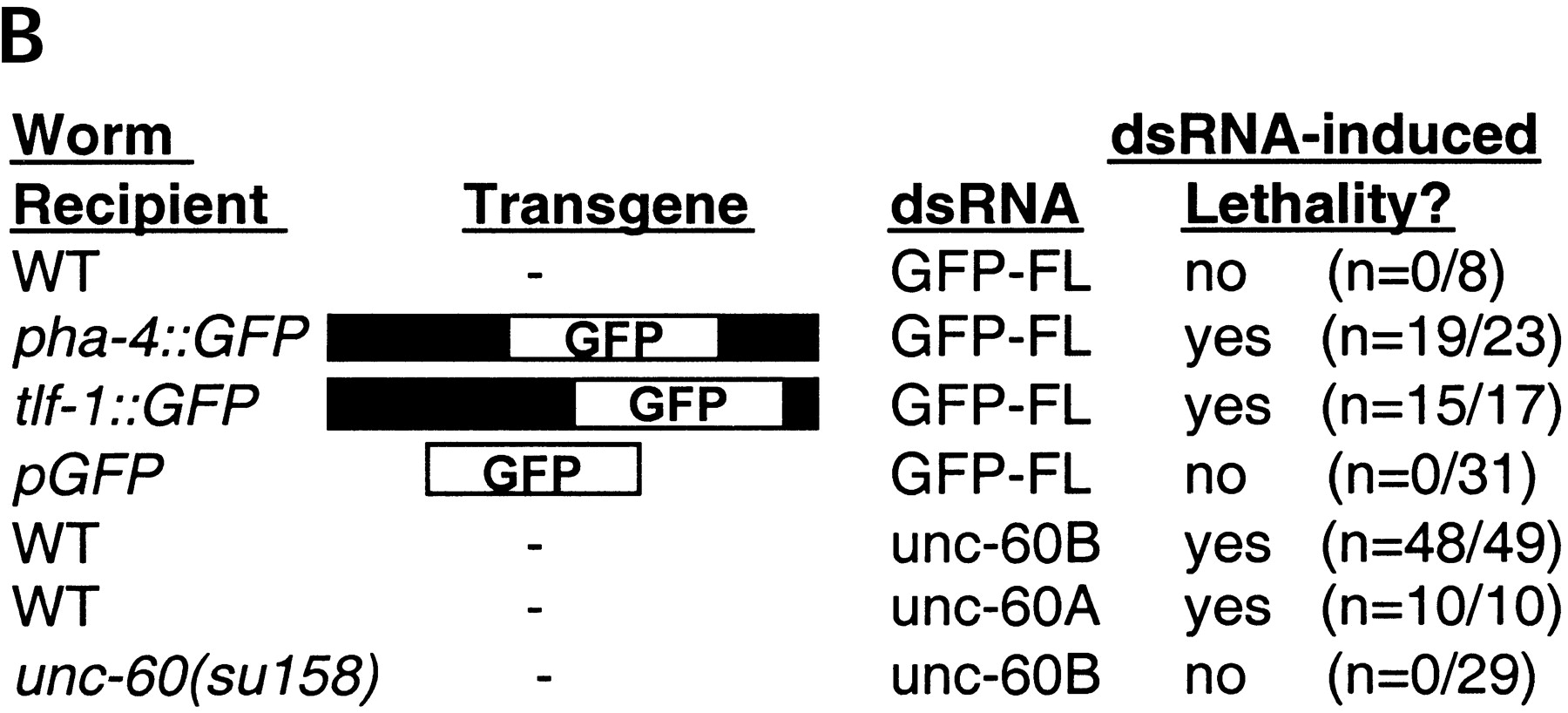
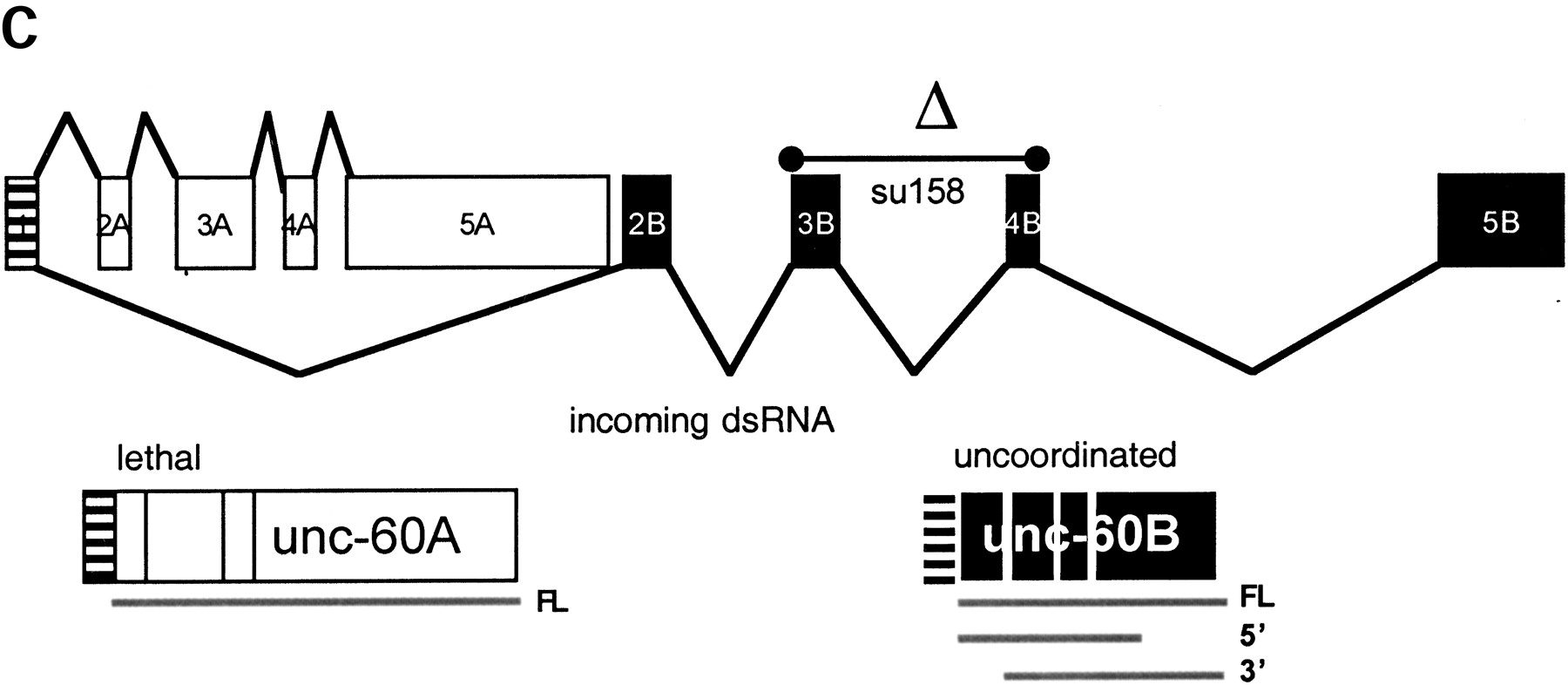
Genetic evidence for dsRNA amplification in vivo. (A) If target mRNA functions as a template for synthesis of new dsRNA, then dsRNA directed against a translational fusion between GFP (green) and a C. elegans gene (red) will lead to the production of new dsRNA that can target the endogenous C. elegans gene (red lines). This phenomenon is called transitive RNAi. Here and throughout, target mRNAs are depicted as boxes and dsRNA as lines. (B) Injection of full-length GFP dsRNA (GFP–FL) leads to killing of pha-4::GFP and tlf-1::GFP worms but not pGFP or wild-type animals (top four rows). Injection of full-length unc-60B dsRNA kills wild-type worms but not unc-60B mutants (bottom two rows). (n′) The number of mothers whose progeny were scored except for unc-60B where mothers were typically scored. A total of 83% of wild-type animals injected with unc-60B dsRNA died and, for the surviving mothers, none of their progeny survived. (C) unc-60 produces two mRNAs, A and B, which share a common first exon (hatched box). RNAi is initiated using unc-60B dsRNA and progeny animals scored for lethal (unc-60A+B) or uncoordinated (unc-60B) phenotypes. (FL) Full-length 453-bp dsRNA for either unc-60A or unc-60B. (5′) 358-bp dsRNA located 2 nucleotides from the exon 1/2 boundary. (3′) 360-bp dsRNA located 96 nucleotides from the exon 1/2 boundary.




