


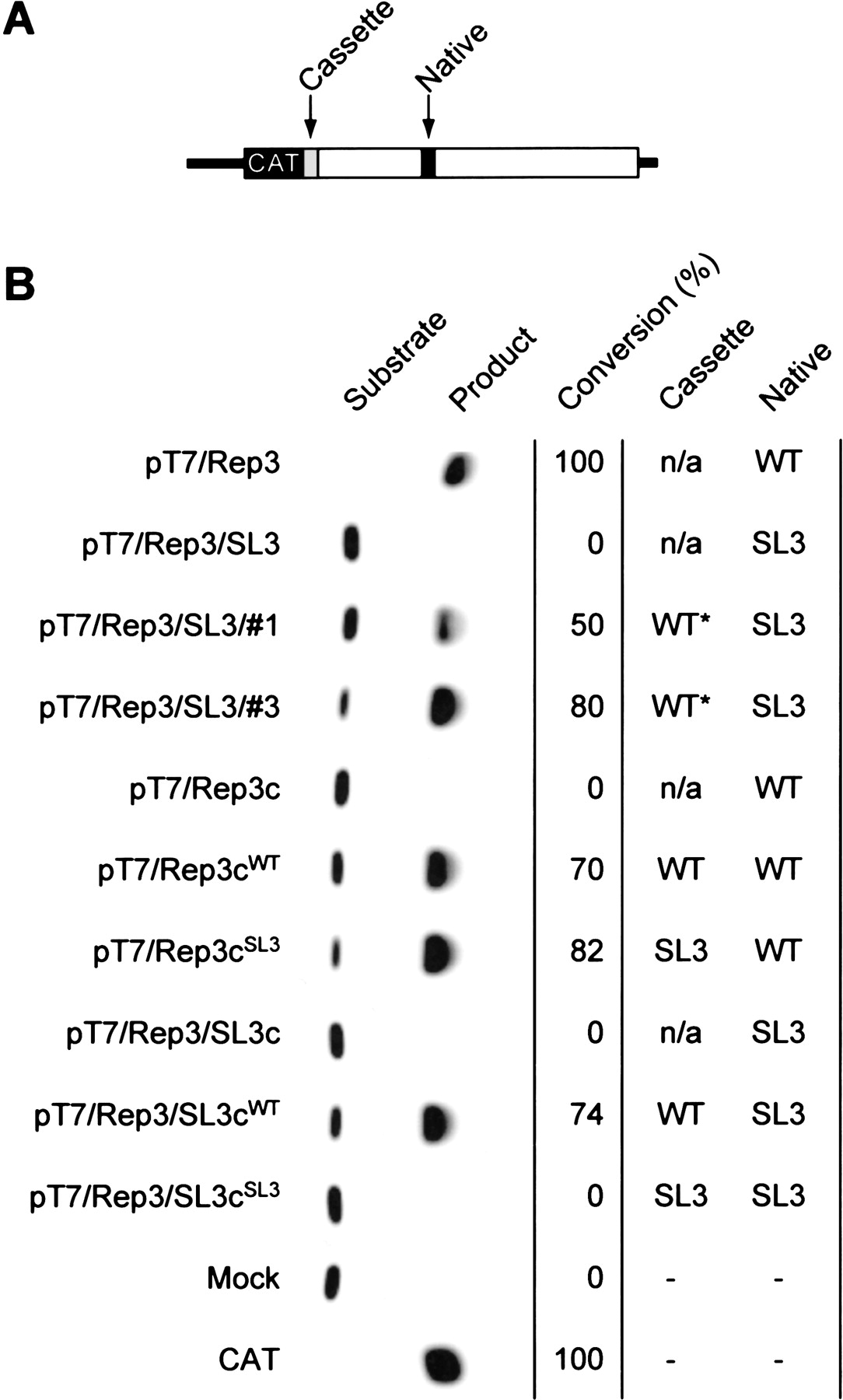

CAT activity of CRE cassette vector-derived replicons. (A) Reference diagram indicating the cassette and native locations for CRE sequences. Refer to Figure 1B for further details. (B) Replication activity of CAT-expressing subgenomic replicons containing duplications of the CRE. The name of the replicon cDNA is indicated in the left-hand column next to a phosphorimager-generated image of the 14C-labeled substrate and monoacetylated CAT products separated by thin-layer chromatography. The proportion of substrate converted to product is indicated (in percent). The columns labeled ‘‘Cassette’’ and ‘‘Native’’ indicate the CRE sequences present in the two positions of the genome; see (A). WT and SL3, respectively, refer to the native CRE sequence or a CRE containing eight nucleotide substitutions designed to disrupt the CRE structure (Goodfellow et al. 2000). WT* indicates native CRE sequences as previously published (Goodfellow et al. 2000). N/A indicates not applicable, where no CRE sequences are present at a particular location. (C) Predicted structures of synthetic CRE sequences used in replication studies. Synth3 to Synth5 are derived from Synth2 by sequential replacement of one to three CG base pairs (highlighted with numerical superscripts in Synth2) with UG pairs. These are shown separated to emphasize the differences, but are predicted to adopt standard Watson-Crick base pairing. The single-point mutation of A1 to C in the 1A2A3CA motif, introduced during the construction of Synth2mut7 is also indicated. (D) Replication of CAT-expressing subgenomic replicons containing synthetic CRE sequences. Layout and labeling as in (B), Syn indicates the presence of a synthetic CRE sequence. Each assay shown in (B) or (D) used normalized levels of total cell protein (5–50 μg). Comparison of replication activity between (B) and (D) cannot be made as the control (pT7/Rep3) reaction in (B) was allowed to progress to completion to emphasize differences in the replication of dual CRE containing replicons.




