


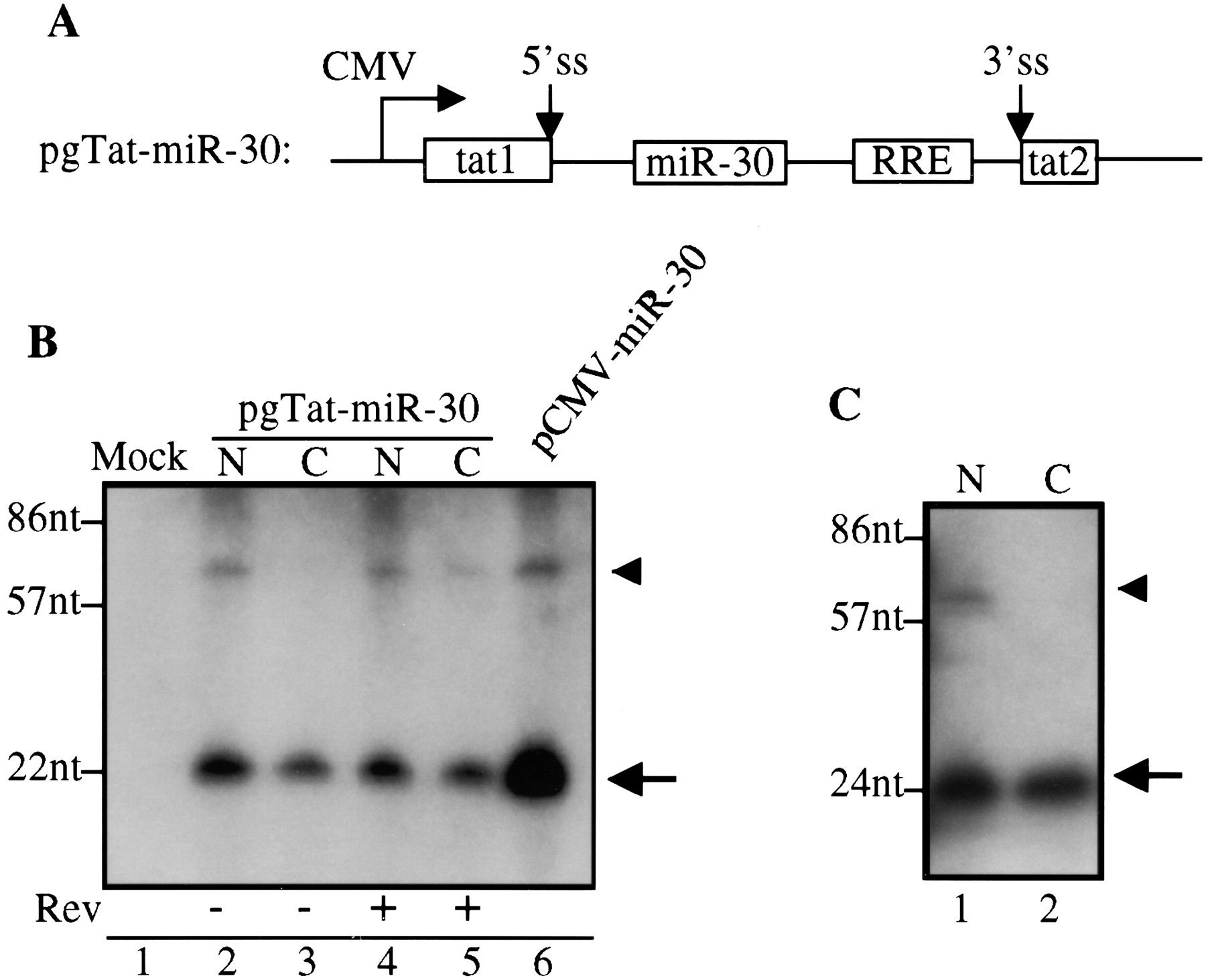
Subcellular localization of miRNAs. (A) Schematic of pgTat-miR-30. (B) Northern blotting for miR-30. Positions of DNA markers are shown in the left. The arrow marks the position of the mature miRNA and the arrowhead indicates the ∼65-nt pre-miRNA. Lane 1, RNA from mock transfected cells; lane 2, nuclear RNA from cells transfected with pgTat-miR-30; lane 3, cytoplasmic RNA from cells transfected with pgTat-miR-30; lane 4, nuclear RNA from cells transfected with pgTat-miR-30 and pcRev; lane 5, cytoplasmic RNA from cells transfected with pgTat-miR-30 and pcRev; and lane 6, total RNA from cells transfected with pCMV-miR-30. (C) Northern blot containing nuclear RNA (N) and cytoplasmic RNA (C) from nontransfected 293T cells was probed with an anti-miR-30-specific oligonucleotide. Labeling is the same as in B. Although detection of the endogenous anti-miR-30 required a much longer exposure than did detection of the exogenously expressed miR-30, it remains unclear why we were consistently unable to detect an endogenous miR-30 precursor signal in lane 1 of B.




