


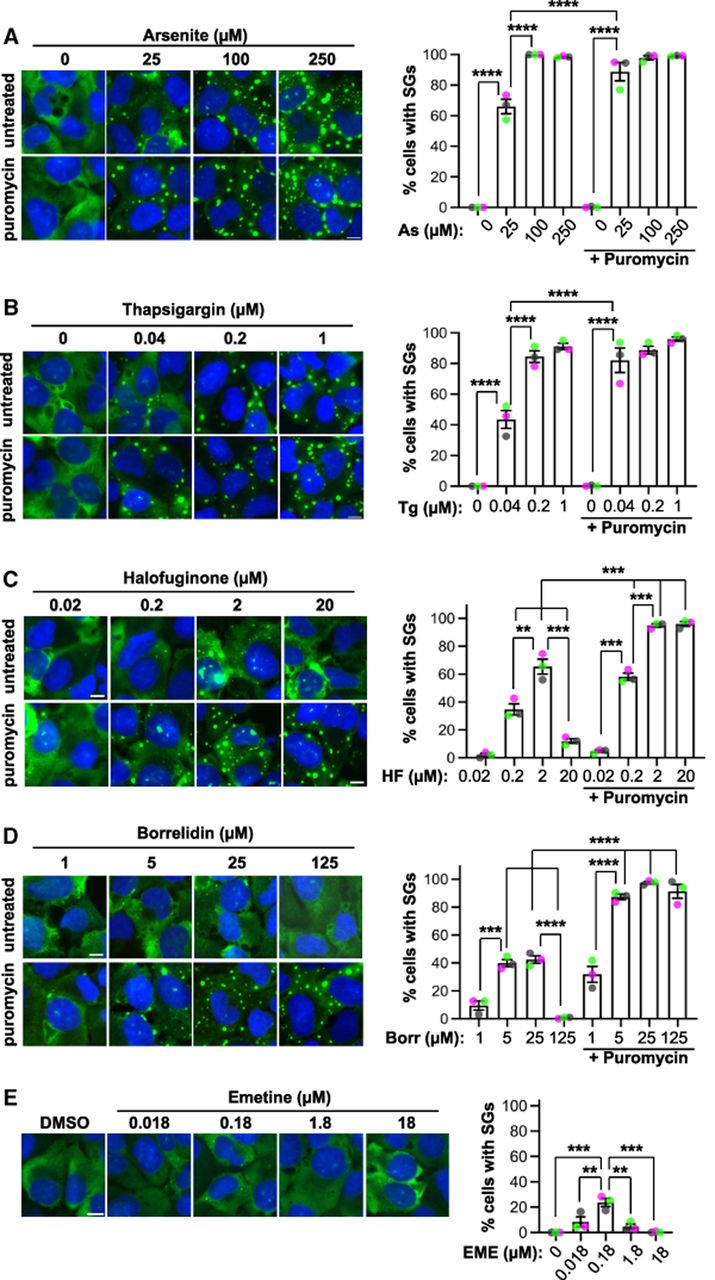
Low-to-intermediate concentrations of tRNA synthetase inhibitors induce stress granules limited by mRNA association with ribosomes. (A) U-2 OS cells expressing GFP-G3BP1 (green) were treated with arsenite (25–250 μM, “As,” 1 h) in the presence or absence of puromycin (10 µg/mL); nuclei stained with Hoechst (blue). (B) Cells were treated with thapsigargin (0.04–1 μM, “Tg,” 1 h) in the presence or absence of puromycin (10 µg/mL). (C) Cells were treated with halofuginone (0.02–20 µM, “HF,” 4 h), with or without puromycin (10 µg/mL) for the last 30 min. (D) Cells were treated with borrelidin (1–125 µM, “Borr,” 4 h) in the presence or absence of puromycin (10 µg/mL) for the last 30 min. (E) Cells were treated with DMSO control or emetine (0.018–18 µM, “EME,” 45 min). Representative images (left) are from n = 3 independent replicates, and the average ± SEM of the percentage of cells with stress granules with green, gray, and pink points showing each replicate value is shown at right. Scale bars, 10 µm. Significance determined with ordinary one-way ANOVA followed by Tukey's multiple comparisons tests; (**) P < 0.01, (***) P < 0.005, (****) P < 0.001.




