


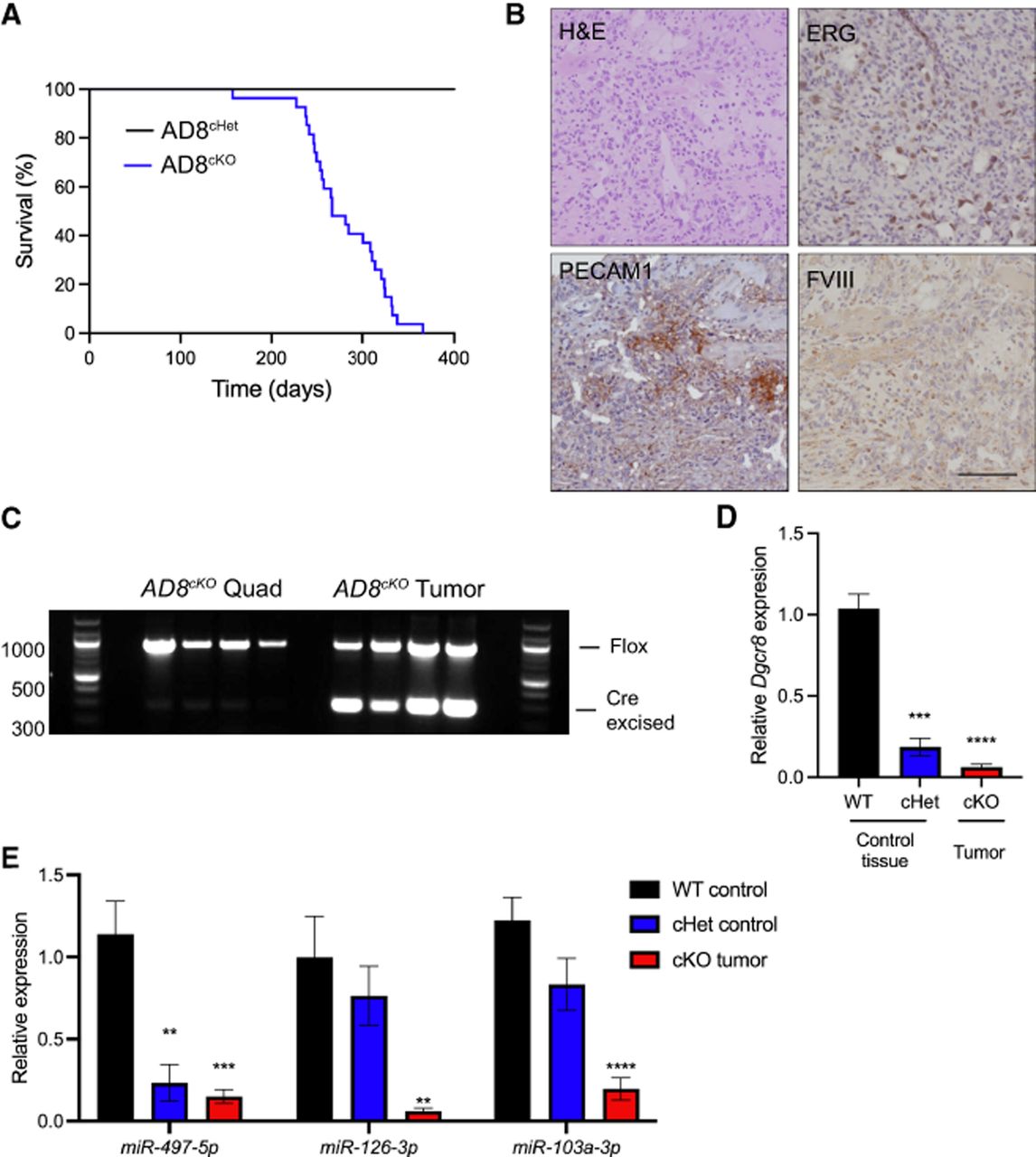
FIGURE 2.
Dgcr8 deletion leads to angiosarcoma development. (A) Kaplan–Meier tumor-free survival curve for aP2-Cre;Dgcr8cHet (AD8cHet, black, n = 28) or aP2-Cre;Dgcr8cKO (AD8cKO, blue, n = 27, median tumor-free survival time of 266 days); Mantel–Cox log-rank P < 0.0001. (B) H&E and IHC for ERG, PECAM1, or Factor VIII (FVIII) from an AD8cKO tumor; scale bar, 100 µm. (C) Genomic PCR of DNA from AD8cKO control quadricep (quad) muscle or AD8cKO angiosarcomas (n = 4). (D) Relative expression of Dgcr8 by RT-PCR from WT and cHet control tissue (n = 3) compared to cKO (AD8cKO) angiosarcomas (n = 3). (E) Relative expression of indicated miRNAs by qRT-PCR from tissue as in D, (**) P < 0.01, (***) P < 0.001, (****) P < 0.0001.




