


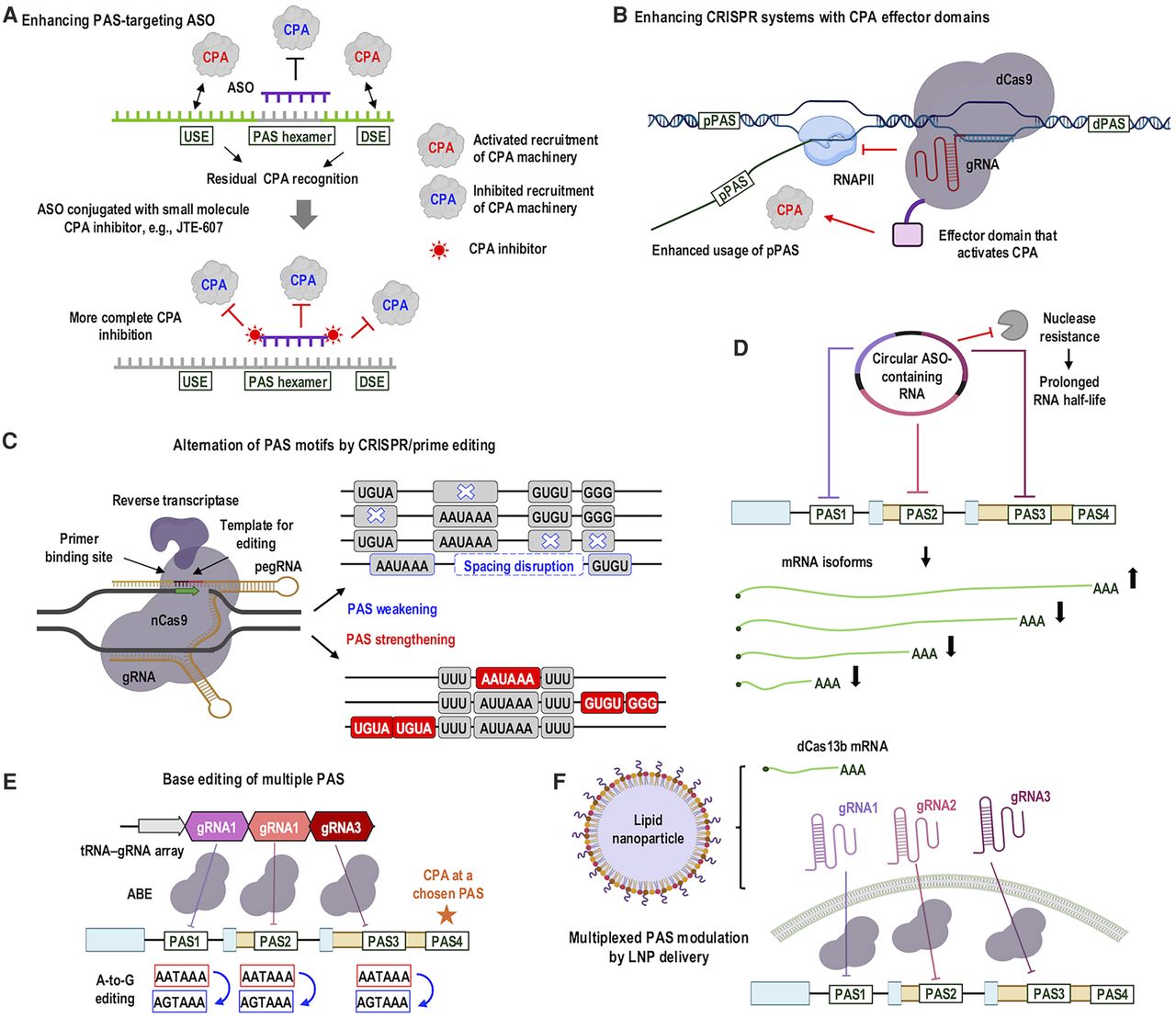
Potential strategies to enhance modulation of PAS usage. (A) PAS-targeting ASOs can be enhanced by conjugation with a CPA small molecule inhibitor, such as JTE-607, to achieve more complete inhibition of CPA for a gene. (B) CPA modulation domains tagged with CRISPR/dCas9 or dCas13 can help with PAS inhibition or activation. The effector domains can help recruit CPA machinery to the PAS or suppress the process (not shown). (C) Alteration of PAS motifs by CRISPR/prime editing. A prime editor (nCas9-reverse transcriptase fusion protein) precisely modifies PAS motifs. Colored boxes denote sequences inserted by prime editing, with red indicating insertions that strengthen PAS usage (e.g., conversion of weak PAS hexamers to stronger variants such as AAUAAA, or insertion of auxiliary UGUA-, GU-rich, or G-rich motifs), and blue indicating insertions that weaken PAS usage (e.g., insertion of random sequences that perturb PAS architecture). Cross symbols indicate sequence disruption by prime editing through deletion or mutagenesis of key PAS motifs. (D) Multiplexed PAS targeting by using a circular RNA containing multiple antisense sequences. As indicated, circular RNAs are quite stable because they are refractory to exonucleases. (E) Expression of multiple gRNAs from a tRNA–gRNA array for multiplexed PAS targeting. (F) Lipid nanoparticles (LNPs) can contain large cargos, enabling delivery of multiple gRNAs as well as the mRNA encoding a large Cas protein (dCas13b indicated in the picture).




