


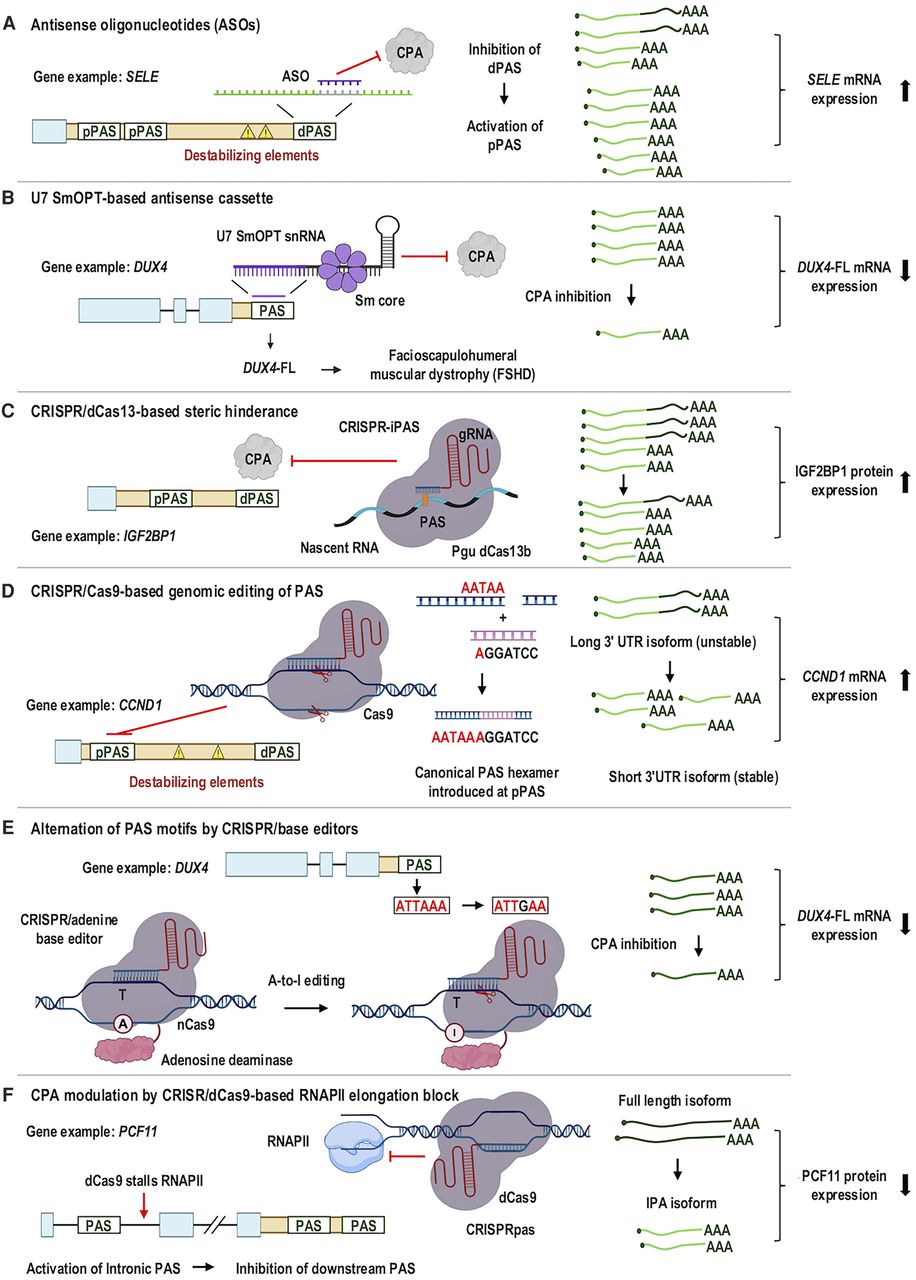
Current methods to modulate CPA at a specific PAS. (A) Antisense oligonucleotides (ASOs) lead to steric blocking of PAS motifs, physically hindering CPA factor binding. In the example gene SELE, ASOs targeting the distal PAS (dPAS) suppress CPA at the site but activate the usage of upstream, proximal PAS (pPAS) and expression of isoforms with shorter 3′UTRs and higher mRNA stability, thereby leading to increased SELE mRNA levels overall. (B) U7 SmOPT–based antisense cassette contains an antisense sequence complementary to its target RNA. In the example gene DUX4, a U7 SmOPT complex targets the disease-permissive PAS in exon 3, suppressing its CPA and leading to reduced DUX4 mRNA and protein levels. (C) CRISPR/dCas13-based steric hindrance of target RNA suppresses binding of CPA machinery. In the example gene IGF2BP1, targeting the dPAS shifts CPA to the pPAS, yielding a short 3′-UTR isoform that is more stable and efficiently translated than the long 3′UTR isoform. (D) CRISPR/Cas9-based genomic editing of PAS removes a PAS or modifies PAS motifs. The double-stranded breaks introduced by CRISPR/Cas9 are repaired by HDR or NHEJ. In the example gene CCND1, donor-mediated HDR inserts “AGGATCC” after the AATAA sequence, creating a canonical AAUAAA PAS hexamer. This much strengthened pPAS leads to substantially increased expression of a short, stable 3′-UTR isoform and hence elevates Cyclin D1 protein levels. (E) Alteration of PAS motifs by CRISPR/base editors. An adenine base editor (ABE) performs A-to-G conversion within the PAS hexamer to weaken or abolish its CPA efficiency. In the example gene DUX4, editing ATTAAA to ATTGAA vastly reduces CPSF recognition, suppressing CPA at the disease-permissive PAS in DUX4. (F) PAS modulation by CRISPR/dCas9-based RNAPII elongation block involves stalling of RNAPII between pPAS and dPAS, forcing the usage of pPAS. In the example gene PCF11, RNAPII stalling enhances intronic PAS, producing a truncated isoform with no apparent functions and hence downregulating gene expression of PCF11.




