


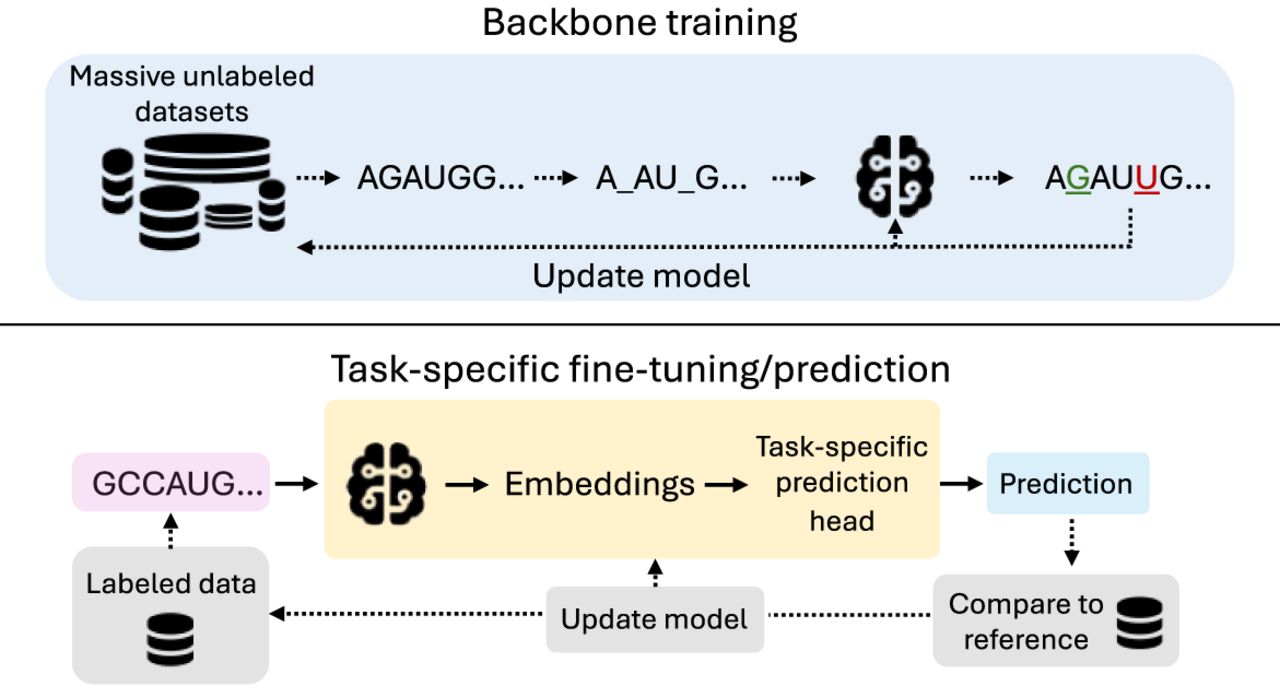
FIGURE 3.
Schematic representation of backbone training (above) and task-specific fine-tuning/prediction (below) for RNA foundation models. Dotted arrows indicate steps that are only included in training. During backbone training, the model learns general “RNA language” features by predicting masked nucleotides from their surrounding context on massive unlabeled sequence data sets. The pretrained backbone can then be fine-tuned on smaller, labeled data sets for specific downstream tasks like secondary structure prediction.




